
En esta noticia
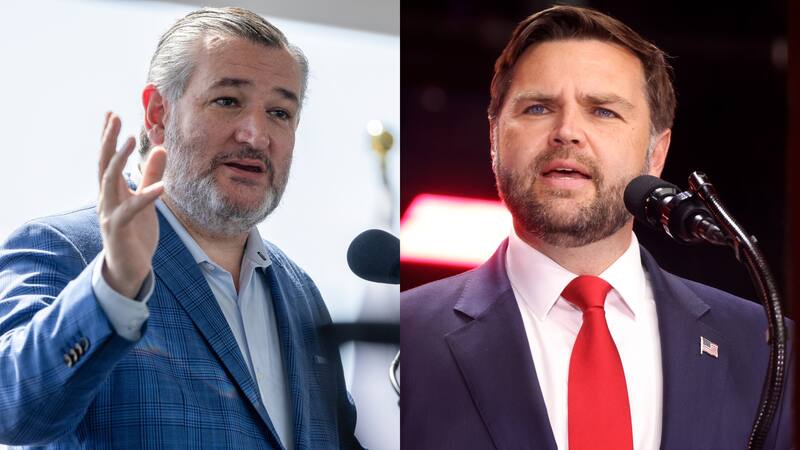
Sen. Ted Cruz, R-Texas, hit back at Vice President JD Vance, suggesting he is “insecure” after Vance accused him of already running for president.
And even though the presidential election is still two years away, the numbers already favor Vance: A recent poll of Republican likely voters puts him ahead of Cruz for the 2028 nomination, 44% to 3%, with Secretary of State Marco Rubio second at 21%.
The Bowling Green State University/YouGov survey interviewed 1,200 likely voters nationwide from Aug. 25 to Sept. 1, with a margin of error of plus or minus 3.3 percentage points. Only the 499 respondents who identified as Republicans were asked about the GOP race.
Neither Vance nor Cruz has launched a 2028 campaign. Both say their priority is the Nov. 3 midterm elections, where Republicans are defending their majorities in the House and Senate.


Why did Ted Cruz call JD Vance ‘insecure’?
The exchange played out over three days, in separate interviews the two Republicans gave to national outlets.
What JD Vance said about Ted Cruz
Vance opened the exchange in an interview with NBC News on Oct. 1. “It is really obvious to me that, at this very moment, Ted Cruz is running for president,” he said. “At this moment, I’m not. I’m trying to help elect Republicans.”
Cruz had signaled his interest weeks earlier. In August, he told MS NOW he didn’t consider Vance a lock for the nomination and said, “I’ll certainly be part of the discussion.”
How Ted Cruz responded
Cruz fired back in a phone interview with POLITICO on Oct. 3. “In my experience, people engage in political bomb-throwing when they’re feeling insecure,” he said, adding that his focus is winning the midterms over the next 30 days.
To make his case, Cruz pointed to campaign stops in several states, with more planned this month, and said no Republican has campaigned for more candidates over the past decade. One of them, he noted, was Vance, whom he joined on the trail during the 2022 Ohio Senate race.
A Vance spokesperson did not immediately respond, POLITICO reported.

Who is in second place behind JD Vance in the 2028 Republican poll?
According to the last BGSU/YouGov poll, Rubio holds second place at 21%, 23 points behind Vance but 18 points ahead of Cruz. Donald Trump Jr., the president’s eldest son, follows at 8%, and Florida Gov. Ron DeSantis has 7%. Cruz ranks fifth.
Here’s how the full field breaks down among Republican likely voters:
| Candidate | Support |
|---|---|
| JD Vance | 44% |
| Marco Rubio | 21% |
| Donald Trump Jr. | 8% |
| Ron DeSantis | 7% |
| Ted Cruz | 3% |
| Tucker Carlson | 2% |
| Robert F. Kennedy Jr. | 2% |
| Eric Trump | 1% |
| Rand Paul | 1% |
| Josh Hawley | 1% |
| Nikki Haley | 1% |
| Someone else | 9% |
The 9% who picked “someone else” is larger than the combined share of every candidate below DeSantis.
How solid is JD Vance’s 41-point lead over Ted Cruz?
In this poll, the lead is far too large to be explained by sampling error. Vance also leads Rubio by more than 20 points, so his frontrunner status doesn’t depend on Cruz’s weak showing.
Vance’s lead has narrowed since the start of the year, though. In the same pollster’s February survey of registered voters, he had 51% among Republicans and Rubio had 15%.
That means the gap between the top two shrank from 36 points to 23. Because the two surveys used different samples, the comparison shows the direction of the race more reliably than the exact size of the shift.
The Republican sample is smaller than the full poll. The survey doesn’t publish a separate margin for it, but with 499 respondents it is wider than plus or minus 3.3 points. The poll also closed a month before the Vance-Cruz exchange, and the first 2028 nominating contests are more than a year away.
Vance’s standing within the party remains strong. Among Republicans in the survey, 77% view him favorably. Among all 1,200 likely voters, his rating is 37% favorable to 52% unfavorable.