
En esta noticia
Meat trays in different colors found on supermarket shelves can raise questions for shoppers.
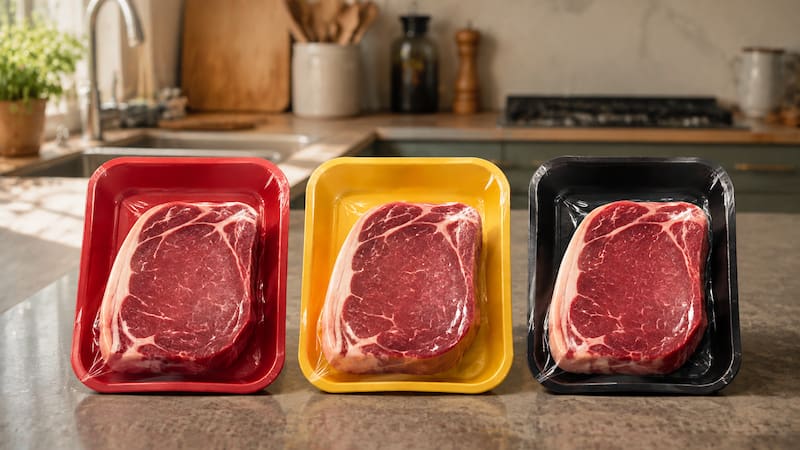
Black, red, yellow or white, these displays often draw attention and lead people to wonder whether they identify cuts of different quality, prices or origin.
But the colors mainly reflect commercial and display choices, not an official health classification. For example, supermarkets may use different shades to distinguish product lines and visually organize their shelves.

What Each Meat Tray Color Means
According to the most common explanation, supermarkets may use colors as a tool to differentiate their products. Although there is no universal rule, some shades are often associated with certain product presentations:
- Black trays: are often used for selected cuts or premium lines. The dark background contrasts with the red of the meat and is meant to convey a higher-value image.
- Yellow trays: may be used for everyday products, promotions or sale items.
- Red trays: are often seen in traditional presentations or standard commercial lines.
- White trays: are used as a standard presentation for different cuts of meat.
These associations are only general guidelines and depend on each store chain. One supermarket may use a black tray to highlight certain products, while another may choose it for presentation reasons or because of packaging availability.
That is why color alone does not tell you whether the meat is more tender, fresher, tastier or of better quality. Nor does it by itself identify its origin or the conditions under which it was produced.
How to Tell Whether Meat Is Fresh: What Senasa Recommends
Beyond the color of the tray, there are product features that can help you assess its condition before buying it.
The National Service for Agrifood Health and Quality (Senasa) recommends checking that fresh meat has a firm, elastic texture and no unpleasant odor. It also warns that abnormal coloring, such as dark brown, surface slime and softness, may be signs of spoilage.
For packaged meat that is not sold vacuum-sealed, the agency says it must have a pink color and be kept refrigerated. The shelf must have a visible thermometer showing a temperature between 0 and 5 C.
In addition, the package must be intact, with no tears or punctures, to ensure the food is protected.

What to Check on Meat Tray Labels
Another important step when buying meat is reading the information on the label. This helps you identify where the product comes from, the cut and the details related to how it was produced and stored.
According to Senasa, packaged meat products must include information that identifies their origin and shows their production and expiration dates.
Among the details worth checking are:
- Product name: identifies the cut of meat being purchased.
- Production and expiration date: shows when it was prepared and until when it can be sold or eaten under the established conditions.
- Origin identification: shows where the food comes from.
- Lot identification: makes the product traceable.
- Storage conditions: indicate how it should be kept to preserve its safety.
The Argentine Food Code, through its labeling rules, sets the information requirements that packaged foods must meet. In turn, ANMAT’s manual on hygienic food handling explains that the label must be complete and legible to provide information about the product’s characteristics, composition and storage.