
En esta noticia
The traffic signs play a fundamental role in road safety, as they allow drivers to be warned about restrictions and specific road conditions. In the United States, there is a yellow pennant-shaped sign that may be unfamiliar to some motorists.
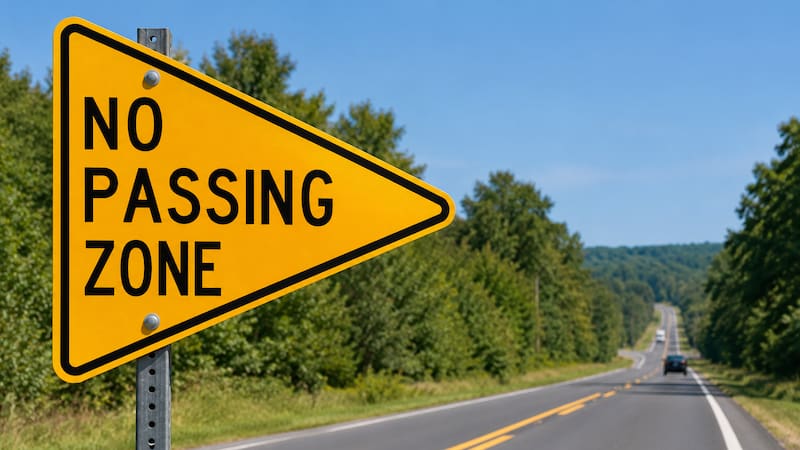
This is the NO PASSING ZONE sign, which indicates the beginning of a stretch where passing other vehicles is prohibited.
According to the Manual on Uniform Traffic Control Devices, published by the United States Federal Highway Administration, this sign is identified with the W14-3 code and has specific design and placement characteristics.


What does the yellow pennant-shaped sign mean?
This sign means the driver is entering a zone where passing maneuvers are not allowed.
It is distinguished by its elongated triangular shape, similar to a pennant, with a yellow background, black border and the inscription NO PASSING ZONE.
According to the FHWA, its design corresponds to an isosceles triangle whose longest axis is horizontal and whose point faces to the right.
The sign is installed on the left side of the road, at the start of areas where passing is prohibited and that are identified by pavement markings, prohibition signs or both.
What should drivers do when they encounter this sign?
When encountering the sign, motorists must respect the passing prohibition corresponding to that stretch.
This means:
- Do not try to pass another vehicle by means of a prohibited maneuver in that area.
- Pay attention to the pavement markings, which also indicate passing restrictions.
- Keep a safe distance from the vehicle ahead.
- Wait until you reach a section where passing is allowed before making that maneuver.

Why is this sign placed on the left side of the road?
Unlike many other traffic signs, the NO PASSING ZONE is located on the left side of the road.
This placement is part of the specifications established by the FHWA to identify the start of areas where passing is not allowed.