
En esta noticia
It looks like a kitchen experiment, but it has an academic source. Researchers at the University of Florida’s Institute of Food and Agricultural Sciences (UF/IFAS) list it in their fact sheet on homemade household cleaners. The answer to what the mix is for is simple: it is an all-purpose cleaner.
How to make a homemade cleaner with vinegar and orange peels
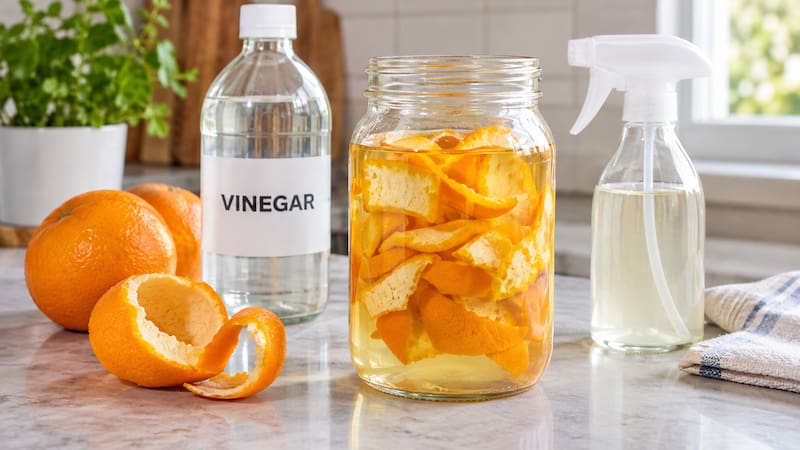
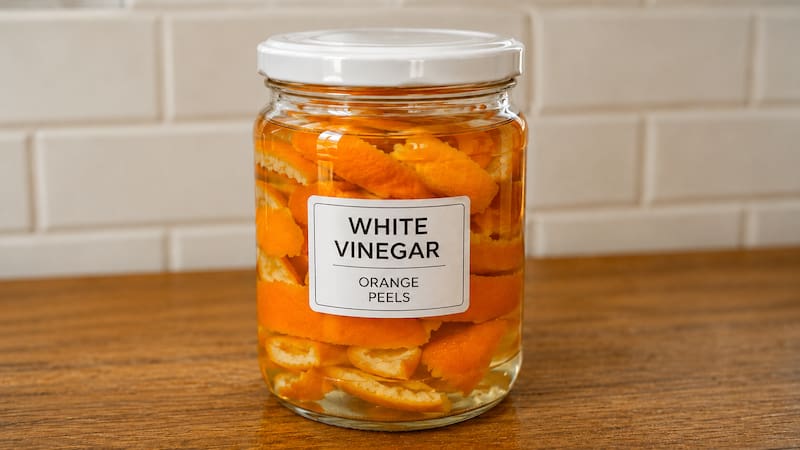
The recipe asks for very little. You need the peels of four oranges, a quart-size glass jar and enough white vinegar to cover them. Once the jar is filled, it rests for about a week. After that, the liquid goes into a spray bottle and it is ready for everyday surfaces.
There is no cooking, measuring or special equipment. The authors, Amanda Griffin and Randall A. Cantrell, present it as an example of the cleaners you can make with a few inexpensive ingredients instead of buying commercial products.
What surfaces can you clean with vinegar and orange peels?
A mixture of white vinegar and orange peels can be useful for cleaning certain hard surfaces around the home, particularly those that tolerate acidic products. Once the mixture is ready, it can help remove light grease, everyday dirt and some unpleasant odors, while leaving a fresh citrus scent.
It may be suitable for ceramic tiles, certain kitchen countertops and other washable, acid-resistant surfaces. However, it is important to test the mixture on a small, inconspicuous area before using it more broadly.
Avoid using it on marble, granite, natural stone, terrazzo and other acid-sensitive materials, as vinegar can damage their finish. It is also best to avoid unsealed wood, waxed surfaces and delicate finishes.
Why people reach for it
The first reason is the budget. The fact sheet opens by asking whether you are running low on cleaners and suggests making your own rather than heading to the store.
The second is reuse: the peels would otherwise be thrown away, and the jar can be a recycled one.
What it does not promise
The University of Florida calls this mix an all-purpose cleaner. It does not describe it as a disinfectant. For sanitizing hard surfaces such as cutting boards or doorknobs, the same university gives separate diluted bleach solutions, with their own instructions.
Safety rules that matter more than the recipe
The most important warning has nothing to do with oranges. Never mix bleach with vinegar, ammonia or rubbing alcohol, because the reaction can release toxic fumes that harm the lungs. Since this cleaner is vinegar-based, keep it away from any bleach product.
The fact sheet adds a few habits worth adopting:
- Label the jar or bottle clearly.
- Never use food containers, especially ones children associate with food.
- Store the cleaner out of children’s reach.
- Mix only what you need and use it up.