
En esta noticia
China expanded its presence in Latin America through investments in infrastructure, energy and transportation. One of the most important projects in that expansion is Coca Codo Sinclair, one of the region’s largest hydroelectric dams, located in Ecuador, built with the participation of Chinese state-owned companies and financing from a bank in the Asian country.
The plant was inaugurated in November 2016 and has an installed capacity of 1,500 megawatts (MW). Construction was carried out by Sinohydro, a company belonging to the state-owned POWERCHINA group, while China’s Eximbank provided 70% of the project financing, whose total investment was about $2,000 million.


The project was developed with the goal of increasing Ecuador’s power generation, meeting domestic demand and reducing dependence on energy imports. Its operation also helped strengthen the country’s energy mix and made the plant a key part of its power infrastructure.
What the hydroelectric dam China built in Ecuador is like
The Coca Codo Sinclar hydroelectric plant is located between the provinces of Napo and Sucumbíos in Ecuador. Construction began in July 2010 and it was inaugurated on Nov. 18, 2016, at an event led by then-presidents Rafael Correa and Xi Jinping. However, final acceptance of the work was not formalized until April 2026, after years of unresolved contractual issues.
With an installed capacity of 1,500 megawatts (MW), it is the country’s largest hydroelectric plant and one of Latin America’s most important energy projects.
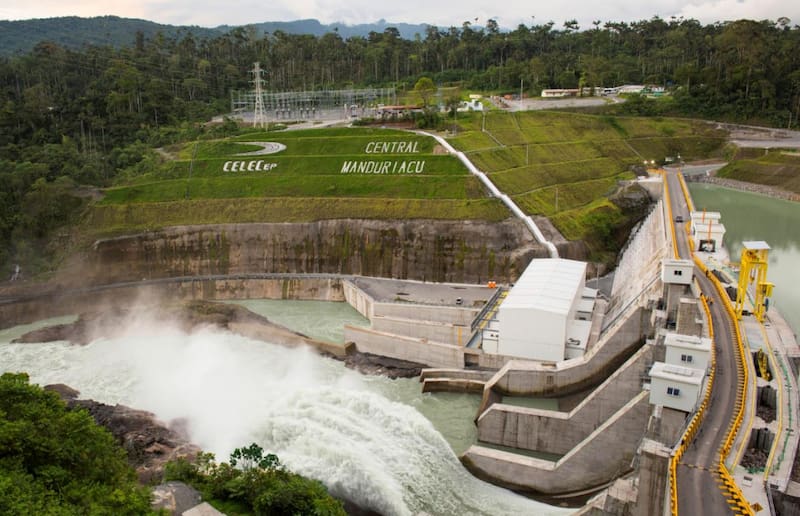
The infrastructure uses the flow of the Quijos and Salado rivers, which form the Coca River, and has eight 187.5 MW Pelton turbines. Water travels through a 24.83-kilometer conveyance tunnel and drops about 620 meters before reaching the powerhouse, where electricity is generated. According to Ecuador’s Ministry of Environment and Energy, the plant supplied more than 28,339 GWH to the national electric system between April 2016 and December 2020.
How China took part in financing and building the dam
China’s participation took place through two state entities, with builder Sinohydro in charge of the engineering contract, equipment and materials supply, civil works and commissioning of the plant. In this regard, the company is part of POWERCHINA, a Chinese state-owned business group specializing in infrastructure and energy projects.
On the other hand, the state-owned Export-Import Bank of China (China Eximbank) provided US$1,682.7 million to finance the project, equal to 70% of the financing reported by the Ecuadorian Electric Corporation (CELEC EP). The rest came from an Ecuadorian counterpart, bringing total project investment to approximately US$2,000 million.
Why Coca Codo Sinclair was built and how much electricity it generates
The main goal was to increase Ecuador’s power generation capacity to meet growing demand and reduce dependence on imported energy. According to the official project sheet published by CELEC EP, the plant was designed to provide a more reliable electricity supply, avoid possible rationing and replace part of thermal generation, which uses petroleum-derived fuels.
With an estimated average annual output of 8,734 gigawatt hours (GWh), the plant can supply more than 30% of national electricity demand, according to data released by CELEC EP at its inauguration. The agency also said that generation was enough to supply all Ecuadorian households. In addition, bringing it online reduced the need to import fuel for thermal plants and created the possibility of producing surplus power for export to neighboring countries.