
En esta noticia
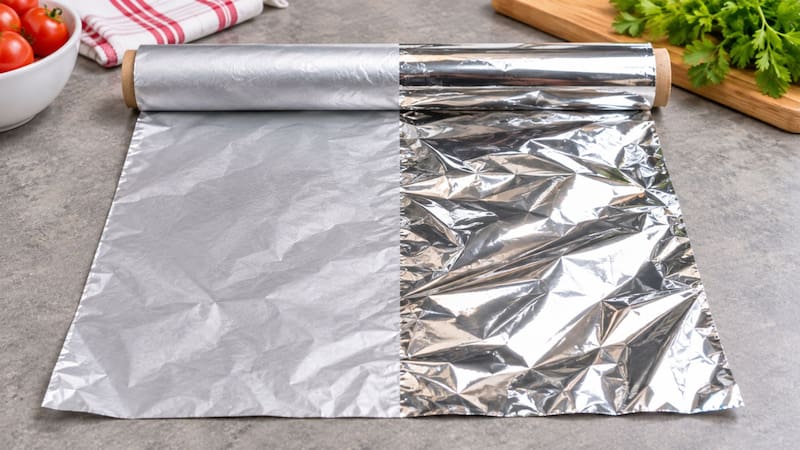
Aluminum foil is one of the most commonly used items in the kitchen for storing food, covering containers, and preparing baked dishes. But its two surfaces raise a common question: should the shiny or dull side touch the food?
Although many people believe each side has a different role in retaining or reflecting heat, there is a scientific explanation and an answer from manufacturers that make clear which side to use and why the difference in appearance exists.


The real reason aluminum foil has a shiny side and a dull side
The difference between the two surfaces of aluminum foil comes from the industrial manufacturing process. In the final stages of production, the material passes through rollers that reduce its thickness until it becomes a very thin sheet.
To keep it from tearing during this process, manufacturers place two layers of aluminum together and run them through the rollers at the same time. As a result, the surfaces that come into contact with the polished metal of the machinery get a shiny finish, while the surfaces facing each other have a dull appearance.
This explanation is documented by Reynolds, a manufacturer of household aluminum foil, and by research on industrial aluminum rolling published in scientific journals, such as the study “Experimental investigation of surface roughening of the matte side in pack rolling” published in the Journal of Materials Processing Technology.
Is there a correct side of aluminum foil for cooking?
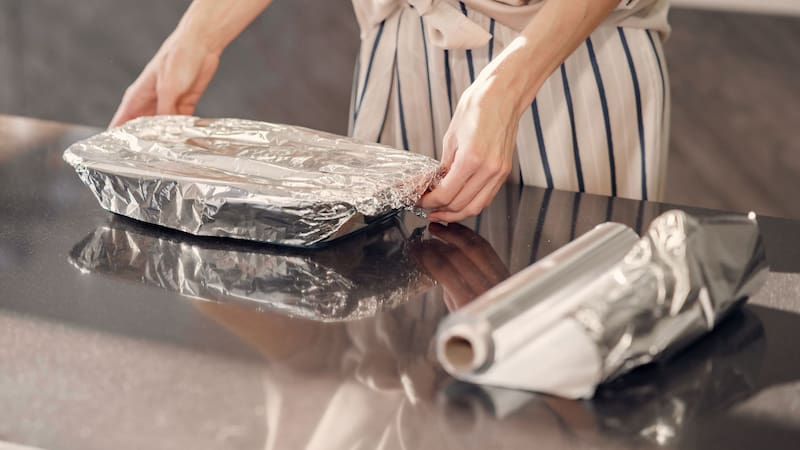
With standard aluminum foil, it does not matter whether the shiny or dull side touches the food. Both surfaces can be used interchangeably to wrap food, cover containers, cook in the oven, or store prepared dishes.
Reynolds explains in its official usage guide that the difference in appearance is a result of the manufacturing process and does not affect the product’s performance. So placing the shiny side in or out does not noticeably change the cooking result.
The belief that the shiny side retains more heat or cooks food faster has no practical basis for standard aluminum foil.
What does science say about the difference between the two sides?
A scientific study published in 2020 in the journal Biotechnology Reports, titled “Reflectivity measurements of the matte and shiny sides of household aluminum foil: application to the design of a light concentrator for photobioreactors”, analyzed the reflective properties of the two surfaces of household aluminum foil.
The researchers measured the reflectivity of both sides and found differences in the way they reflect light: the shiny surface has greater specular reflection, while the dull side has greater diffuse reflection.
However, the study also found that both surfaces have virtually the same total reflectivity: about 86% in the visible spectrum and 97% in the near-infrared.
These results help explain why the two sides look different but have similar overall reflective properties. The study did not directly evaluate food cooking times.
Is there any exception where the side does matter?
There is a type of aluminum foil that comes with a nonstick coating, which has a special finish designed to keep food from sticking to the surface.
On these products, the manufacturer indicates which side should touch the food. In the case of Reynolds nonstick foil, the dull surface has a special treatment and should face the food.
So before using it, it is a good idea to check the package and the product instructions.