
En esta noticia
The school where the philosopher Aristotle trained Alexander the Great more than 2,300 years ago, future conqueror of an empire that stretched from Greece to India, has been identified at an archaeological site in northern Greece.
The discovery has been announced by the Greek Ministry of Culture and confirmed this Thursday by Angelikí Kottaridi, the archaeologist who leads the excavations in the region of Emathia.
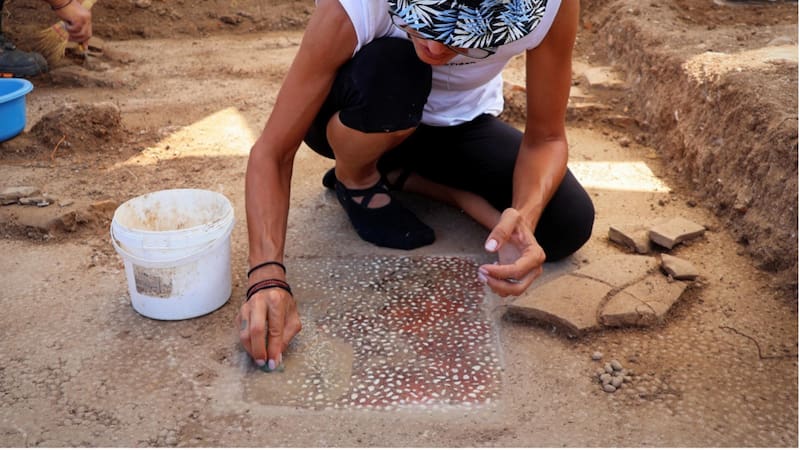
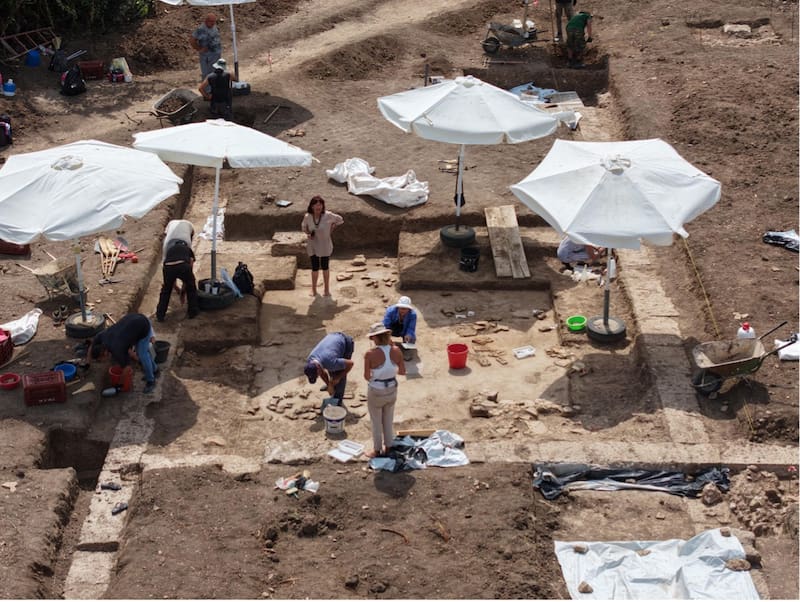
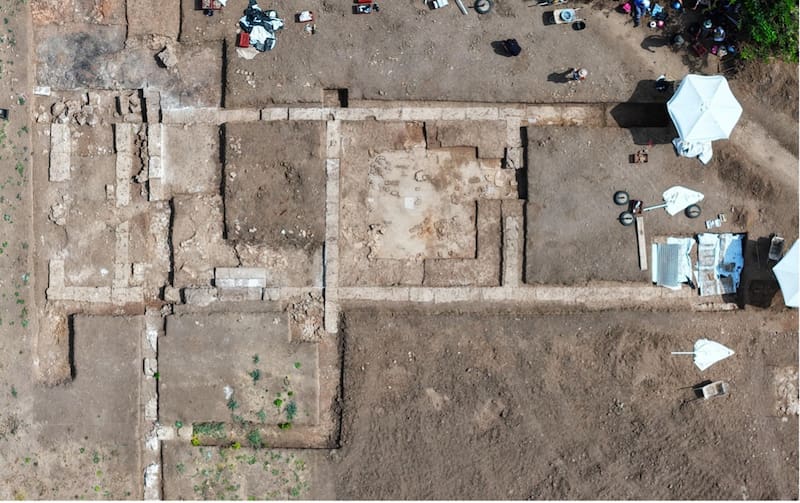
Researchers have located the site in the ancient Macedonian city of Mieza, a complex of about three hectares that preserves teaching classrooms, banquet halls, a sports pavilion, an athletics stadium and a 200-meter covered running track. In this context, excavations in Mieza began in 2024 and this year will continue focused on the area of the sports pavilion and the teaching classrooms.

This is what the school where Aristotle educated Alexander the Great was like
“We are absolutely sure that this is the school founded by Philip II”, king of Macedonia from 359 BC until his assassination in 336 BC, the year in which his son, Alexander the Great, at the age of twenty, succeeded him on the throne, Angelikí Kottaridi tells EFE.
Among the ruins, coins, ceramics and four styli that ancient students used for writing have been found. These objects could provide new clues about the people who received training at the site.
In his work ‘Parallel Lives’, the Roman historian Plutarch recounts that Alexander the Great was a disciple of Aristotle between the ages of 13 and 16. During that period, the philosopher taught him ethics, politics, literature and natural sciences.
Two years later, the young man was already prepared to rule and to take command, in 338 BC, of the cavalry in the decisive Battle of Chaeronea, in which Philip defeated the combined forces of the Athenians and Thebans.
An elite school with classrooms and banquet rooms
Kottaridi stresses that Philip also founded other schools (gymnasia) in Amphipolis and in Aigai, the capital of the Macedonian kingdom, although the one in Mieza was “what today would be described as an elite school”, where the sons of the most illustrious Macedonians were trained for war with classes in tactics, strategy and physical training.
This year a complex of rooms adjoining the classrooms was discovered, including an antechamber and two banquet rooms. They preserve mosaic floors and raised platforms for placing couches that allowed for up to 20 diners.
The school also had a covered running track (xystós) of 200 meters, along which 64 Doric columns were erected. The space was used for physical training during days of extreme cold or heat.
In this structure and in other parts of the site, architectural and decorative elements similar to those of the Macedonian royal palace at Aigai (present-day Vergina), where Philip and Alexander lived, have been recovered, the archaeologist notes.
The education that accompanied Alexander in his conquests
According to Kottaridi, the “most impressive” thing about the discovery is that it shows that the “history of state concern for comprehensive and organized education” did not begin in democratic city-states like Athens, where only private schools existed in which philosophers such as Socrates or Plato taught, but in Philip II’s Macedonia.
“These gymnasiums, where letters, the art of war, culture and the Greek language were learned, will accompany Alexander on his military campaign and become the cornerstone of the Hellenistic period”, which spans from the conqueror’s death in 323 BC. until Cleopatra’s death in 30 BC and the subsequent Roman rule, she explains.
In 334 BC, Alexander the Great began the military campaign with which he defeated Persians, Egyptians and Phoenicians, consolidating in just one decade a vast empire that stretched from Greece to the Indus River valley and from Egypt to Central Asia.

Throughout that territory he founded dozens of cities, among them Alexandria in Egypt, whose most characteristic feature was precisely these schools, which helped spread Greek culture and language to “the peoples of the world of that time”, the researcher points out.
Installations of this type have even been found in places as far away as Afghanistan, in the ancient Hellenistic city of Ai-Khanoum, east of present-day Kabul.