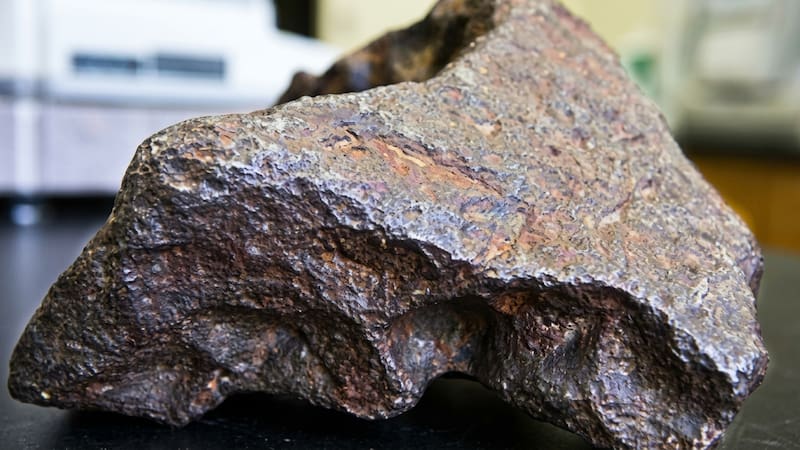

For decades, a heavy rock had a simple job on a Michigan farm: keeping a barn door open. Its real story was far more extraordinary. Years after it became part of the property, scientists determined that the 10.22-kilogram rock was an iron meteorite, later officially recognized as the Edmore meteorite.
The story dates back to 1939, when the object was reportedly found on a farm near Edmore, Michigan. According to the account passed down by the property’s owners, the original owner had seen the object fall and later recovered it from the ground. It eventually became part of the farm’s everyday surroundings and was put to a practical use.
The rock went virtually unnoticed for years. It changed hands along with the property and ended up serving as a barn-door stop, despite the unusual story attached to it.

How the rock attracted scientific attention
Interest in the object returned decades later. In 1988, David Mazurek bought a farm in Edmore and acquired the rock along with the property. The previous owner told him that the object had fallen there decades earlier.
Mazurek kept the rock for years and continued to use it as a doorstop. That changed in 2018, when reports about meteorites found in Michigan prompted him to wonder whether the unusual rock he had owned for decades could also have come from space.

He took it to Central Michigan University, where geologist Mona Sirbescu examined it. The initial tests showed that the object was far more unusual than an ordinary terrestrial rock.
The specimen was roughly triangular, measured about 17 by 20 by 23 centimeters and weighed 10.22 kilograms, or more than 22 pounds. Its surface also contained large indentations and areas covered by a light brown fusion crust, a feature associated with material that has passed through Earth’s atmosphere.
From a Michigan barn to a laboratory
To determine its exact identity, a slice of the specimen was sent to the Smithsonian Institution. Researchers examined its chemical composition and internal structure using microscopic and analytical techniques.
The sample contained kamacite, taenite and schreibersite, minerals commonly associated with iron meteorites. Scientists also identified a Widmanstätten pattern, a distinctive structure produced as iron-nickel alloys cool extremely slowly.

Chemical analyses placed the specimen in the IIIAB group of iron meteorites. Its classification was later entered into the official meteorite record, where Edmore has been an approved meteorite name since January 1, 2019.
The specimen was also notable for its size. At 10.22 kilograms, Edmore became one of the largest meteorites recorded in Michigan.