

En esta noticia
An Earth day seems like an unchangeable measure: 24 hours. However, the planet’s rotation speed does not remain exactly the same. Over the decades, Earth can spin a little faster or slower and cause the length of a day to vary by a few milliseconds.
These differences are too small to be perceived in everyday life, but they contain information about what happens in the depths of the planet.
Now, a study published in Nature found that one of the keys lies in the interaction between Earth’s inner core and the mantle that surrounds it.
Researchers Huifeng Zhang and Mathieu Dumberry, from the Department of Physics at the University of Alberta, developed a model to analyze how different forces inside Earth can modify its rotation speed.
The work concludes that the main mechanism behind the variations that occur over several decades would be a gravitational torque generated by the inner core, although other forces act in the opposite direction and moderate its effect.

Why a day does not always last exactly 24 hours
The 24 hours are a reference based on the time it takes Earth to complete one rotation on its axis. But the planet does not work like a perfectly uniform clock.
Earth’s rotation speed shows fluctuations caused by different processes. Some occur at the surface, such as the movements of ice masses, the oceans, the atmosphere and large earthquakes. Others originate much deeper, in the interaction between the core and the mantle.
When there is an exchange of angular momentum between these layers, rotation can speed up or slow down slightly. The result is a change of just a few milliseconds in the length of the day, but one that can be detected through high-precision geodetic measurements.
The variations that are of particular interest to this study are those that occur on decadal timescales. The authors point out that these fluctuations were already associated with the exchange of angular momentum between the core and the mantle, but it was still unclear which forces were responsible for the process.
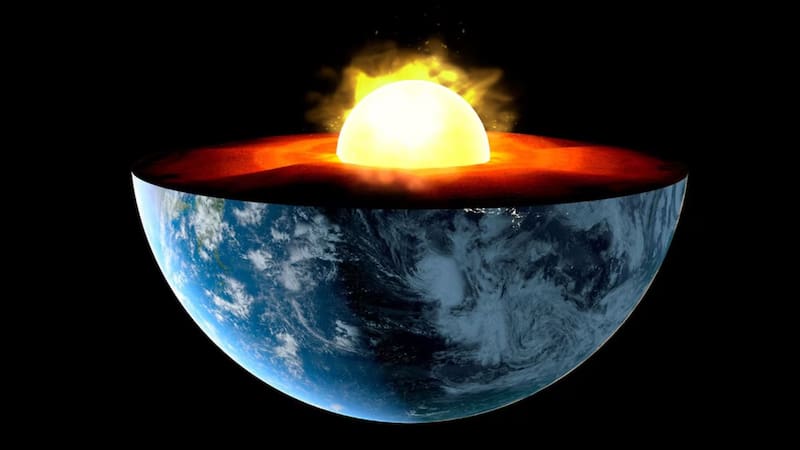
What is at the center of Earth?
Earth’s core is made mainly of iron and is approximately the size of Mars. It is divided into two parts: a liquid outer core and a solid inner core.
The outer core is in constant motion and its liquid metal currents generate Earth’s magnetic field. Inside that fluid layer is the inner core, which can rotate differently from the rest of the planet.
That difference is essential to understanding the new study. The inner core is not a perfectly uniform sphere and contains regions with differences in density. At the same time, the mantle also does not have a homogeneous distribution of materials.
According to the model developed by Zhang and Dumberry, gravity tries to keep certain denser regions of the inner core aligned with density anomalies present in the mantle. When the inner core shifts from that position, gravitational attraction generates a torque that can modify the planet’s rotation.
The inner core maintains a kind of “tug of war”
The research describes a competition of forces. The gravitational torque tends to align the inner core with the mantle, while movements in the outer core generate effects that can oppose it. The researchers incorporated electromagnetic and topographic torques at the boundary between the core and the mantle into the model. By considering these mechanisms, the model better reproduces the observed variations in day length.
What the researchers analyzed
To reach these conclusions, they combined two types of information. On one hand, they used seismic reconstructions of the differential rotation of the inner core, that is, how it moves relative to the rest of the planet. On the other hand, they incorporated models of the outer core flow developed from observed changes in Earth’s magnetic field.
One of the foundations of the work was a study published in 2023 that used seismic waves produced by earthquakes to estimate how the rotation of the inner core had changed since the 1960s. Those data showed that the inner core was spinning slightly faster than the rest of the planet until around 2010 and that later it began to do so more slowly.
With that information, the researchers built a model capable of comparing the contribution of the different forces and reconstructing variations in day length over several decades.
The study was published on September 23, 2026 in Nature, under the title Gravitational torque drives multidecadal variations in length of day.

What they found and why it matters
In simple terms, the main result is that the model better explains changes in day length over several decades when the inner core’s gravitational torque is the dominant factor. Electromagnetic and mechanical effects act as resistance and moderate that movement.
This does not mean that the inner core is the only cause of changes in Earth’s rotation. Other processes that occur on different time scales are also involved.
The study also provides clues about regions of Earth’s interior that cannot be observed directly. The results suggest particular structures in the deepest part of the mantle and a layer rich in iron and highly conductive at its base. They also indicate that the inner core could deform over periods of a few years.
Ultimately, those small millisecond variations in day length make it possible to study processes that occur thousands of kilometers below the surface.