

En esta noticia
Astronomers have made a breakthrough in the study of worlds beyond the Solar System by directly detecting radio emissions from an exoplanet. The signal came from Beta Pictoris b, a young gas giant located roughly 64 light-years from Earth, providing scientists with a new way to investigate the magnetic environment of a distant planet.
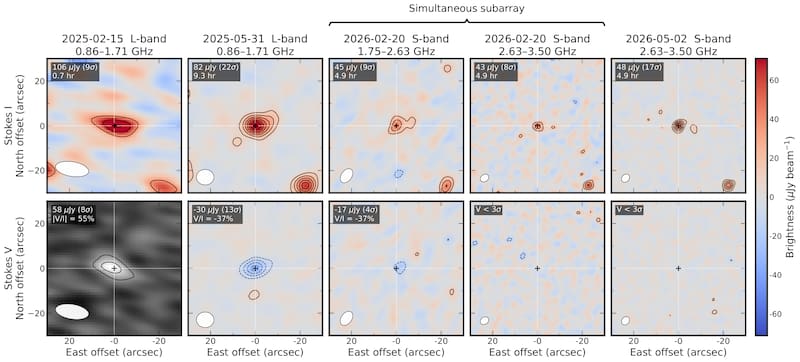
The discovery was made using MeerKAT, a network of radio telescopes in South Africa. Researchers detected recurring bursts as well as persistent radio emission from the Beta Pictoris system. The characteristics of the signal, including its strong circular polarization, offered important clues about where the emission originated.
What made the observation particularly significant was the ability to distinguish the planet from its host star. Previous radio detections associated with exoplanet systems had raised the possibility of planetary activity, but scientists could not always rule out the star itself as the source. This time, the radio source was localized directly to Beta Pictoris b, rather than to the star.

The signal is caused by magnetic activity
The discovery does not point to an artificial transmission or evidence of extraterrestrial life. Scientists believe the radio waves are produced by auroral activity generated by the planet’s powerful magnetic field.
A similar process occurs in our own Solar System. Earth’s magnetic field interacts with energetic particles from the Sun, producing the auroras seen near the planet’s poles. The same basic physics can also generate radio emissions, although the environment around Beta Pictoris b is vastly different from Earth’s.
Researchers believe charged particles in the distant planet’s magnetic environment are accelerated and produce radio waves through a process known as the electron cyclotron maser instability.
The resulting emission can travel across interstellar space and eventually be detected by radio telescopes on Earth.
A powerful magnetic field
The frequencies observed by MeerKAT provided another important piece of information. Because the highest frequency of this type of radio emission is related to the magnetic field strength at its source, the researchers were able to estimate the field in the region producing the signal.
The study indicates a magnetic field of at least 1.25 kilogauss at the source on Beta Pictoris b. That makes the observation particularly valuable because magnetic fields are among the most difficult properties of exoplanets to measure directly.
Magnetic fields can influence how planets interact with radiation and charged particles from their stars. They can also provide clues about a planet’s interior and its surrounding magnetosphere.
Beta Pictoris b is an especially interesting target because it is a young, massive gas giant. It belongs to the Beta Pictoris planetary system, located about 63 light-years from Earth, and its youth gives astronomers an opportunity to study planetary magnetic activity at an early stage of evolution.

Why this detection is different
Astronomers have detected radio emission from systems containing exoplanets before. One notable example is YZ Ceti, where researchers observed radio bursts that could be associated with interactions between a planet and its host star.
However, the evidence was not definitive because stellar magnetic activity could not be completely ruled out as the source of the emission.
The Beta Pictoris b observation takes the field a step further. By comparing the radio position with precise astronomical reference points, researchers were able to determine that the emission coincided with Beta Pictoris b and was inconsistent with the location of the host star.
That distinction could have major implications for the study of distant planets. Radio observations may now offer astronomers a new method for investigating exoplanet magnetic fields, allowing them to learn more about planetary interiors, magnetospheres and the interactions between young planets and their stars.