En esta noticia
Cindy Mora’s story shows how discarded materials can become an alternative for home construction. The Costa Rica native was able to get her own home after saving for nine years to buy a piece of land.
However, when she got the lot she ran into another obstacle, since she did not have enough money to build a house for herself and her son Fabrizio.
Her situation changed thanks to a project led by social organizations and private companies, which turned tons of plastic waste into building blocks. With 850 interlocking pieces and more than 800 hours of volunteer work, a house was built in Alajuelita, near San Jose.


A mother saved for nine years to buy land and have her own home
For nearly a decade, Cindy Mora set aside money with the goal of buying land where she could live with her son. She finally managed to buy a lot in Alajuelita, Costa Rica, but the financial effort had consequences, since she no longer had the resources to build the house. Until then, the two shared a room in Cindy’s parents’ house, so having a place of their own was still an unmet need.
The opportunity came through an initiative that brought together Habitat for Humanity Costa Rica, Procter & Gamble (P&G), Urbarium and Ekojunto. The organizations launched a project that combined access to housing with the reuse of plastic waste. That is how Cindy and Fabrizio ended up with a house built on the same lot she had bought after years of saving.
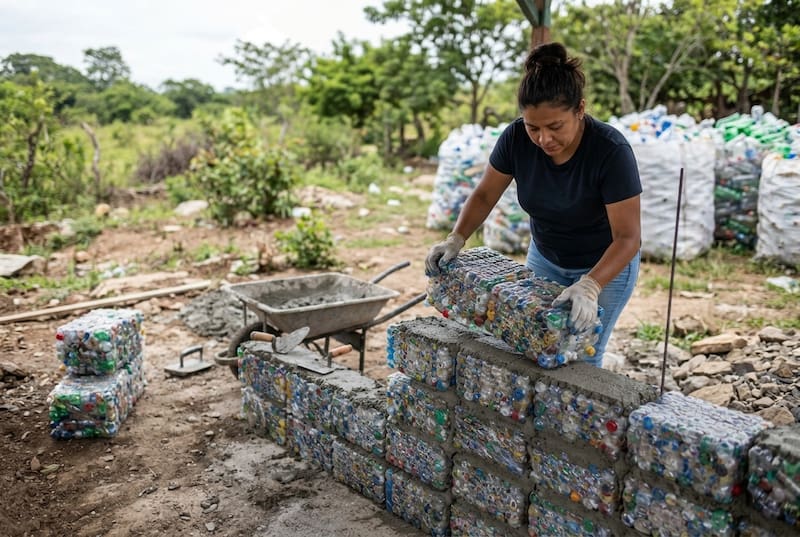
They built the home with 850 recycled plastic blocks that fit together like Legos
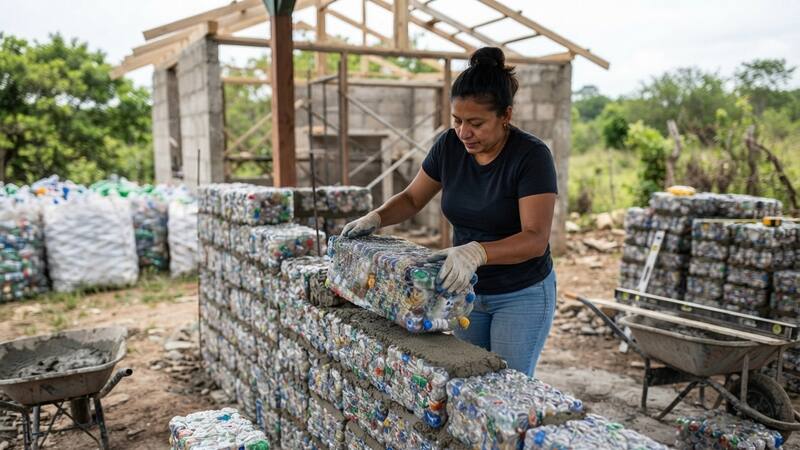
The house is about 72 square meters, and 850 blocks made from plastic waste, including bottles, bags and containers, were used to build the walls. The material was collected and industrially processed using techniques that made it possible to turn it into sturdy, uniform pieces. According to reports on the project, about seven tons of discarded plastic were used to produce the modules used in construction.
One of the system’s key features was its interlocking mechanism, in which the blocks were stacked on top of one another like pieces in a building toy, without needing to join each module using the traditional bricklaying process.
More than 800 hours of volunteer work helped build the house in Costa Rica
Construction began in April 2018 and included volunteers, technicians and workers affiliated with the organizations behind the initiative. Together, they contributed more than 800 hours of work to assemble the structure and complete the house.
The house was handed over to Cindy and her son on May 26, 2018, after the collective effort made it possible to turn waste into materials for a family home.