
By Pedro Bianco
En esta noticia
China is once again leaving its mark on a large-scale infrastructure project in Latin America, this time with a project that promises to become an icon: the Salvador-Itaparica Bridge, in the state of Bahia, Brazil, which will be the longest sea bridge in the region.
At 12.4 kilometers spanning the sea and with a total cost exceeding 11 billion reais, the project is being built and financed by two Chinese state-owned giants, with a contribution from the Chinese consortium of more than $1 billion.

Building Latin America’s longest sea bridge
The project is a 12.4-kilometer bridge stretching almost entirely over water that will cross Todos os Santos Bay in northeastern Brazil. It will have four lanes and an elevated section, rising to more than 80 meters at its highest point to allow large ships to pass underneath.
The bridge will link Salvador, Bahia’s capital and one of northeastern Brazil’s most important metropolitan areas, with Itaparica Island on the other side of the bay. Today, the crossing is made by ferry or motorboat, which means waiting and delays.
With the bridge, the trip will be direct by land and, according to estimates, cut travel time by about two hours to the state’s southern coast, a tourist and industrial area.
China will invest more than $1 billion and could run the bridge for decades
The project is being handled by a consortium led by two major Chinese state-owned companies: China Communications Construction Company (CCCC) and China Civil Engineering Construction Corporation (CCECC), two of the world’s largest infrastructure builders.
The Chinese consortium is contributing about 5.5 billion reais, equivalent to more than $1 billion, or nearly 47% of the total. Brazil’s federal government is contributing about 3 billion reais through its public investment program. The state government of Bahia is contributing about 3.1 billion reais.
The project is structured as a public-private partnership with a 35-year concession model. Under that arrangement, the Chinese consortium builds the project and then operates it, collecting tolls to recover its investment.
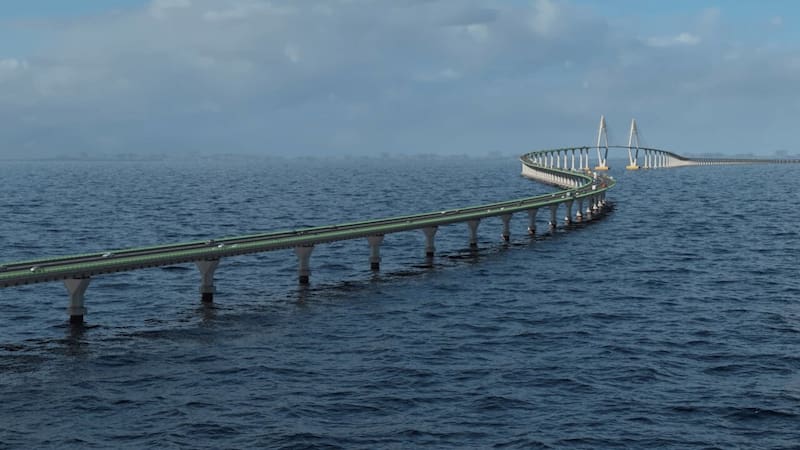
Broadly speaking, the timeline calls for about a year for studies and permits, around five years of construction, and nearly 29 years of toll operations. In other words, China will invest in, build, and run the bridge for decades.
When will it be ready
Work has already begun: the inauguration ceremony took place in 2026, with Brazilian President Luiz Inácio Lula da Silva in attendance. Under the planned schedule, construction would take about five years, with the opening slated for around 2031, although, as with any mega-project, dates could be adjusted as work progresses.