
En esta noticia
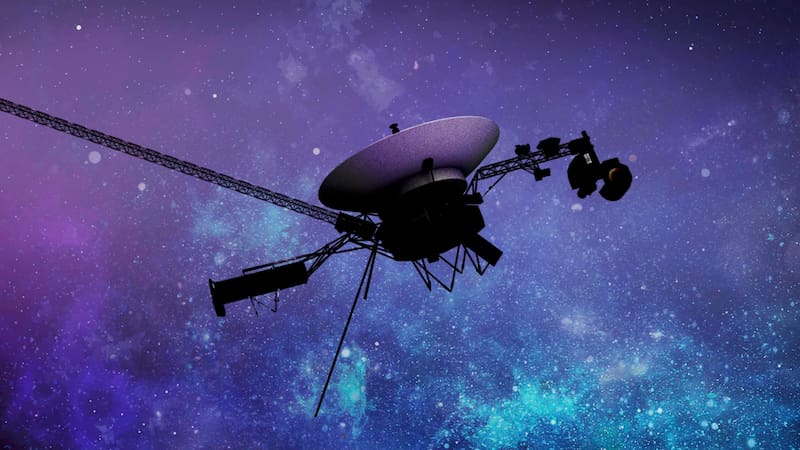
NASA has confirmed a historic milestone for Voyager 1: the farthest spacecraft ever is now one light-day from Earth, after nearly 50 years of travel through space. The human-made object has traveled more than 25 billion kilometers since its launch in 1977 and keeps moving farther from our planet.
The uncrewed spacecraft was designed to carry out a five-year initial mission, but it has remained operational far longer than expected. The head of the U.S. agency, Jared Isaacman, celebrated the achievement and highlighted the work of the scientists and engineers who made possible a journey that has already surpassed the mission’s original expectations, the news agency EFE reported Wednesday.

Voyager 1 reaches a historic distance: what it means to be one light-day from Earth
NASA has confirmed through its official channels that Voyager 1 has reached the milestone of being one light-day from Earth. This measure equals the distance light travels in 24 hours and represents a separation of roughly 25.9 billion kilometers.
The head of the U.S. space agency, Jared Isaacman, celebrated the achievement on social media and called it “extraordinary.” He also highlighted the ability of the teams that built and launched the spacecraft nearly five decades ago.
Reflecting on the significance of the achievement, Isaacman recalled what those “brilliant minds” accomplished with the technology available in 1977 and considered what could be achieved today “and how far we should aim with the tools, resources and ambition of our time.”
Meanwhile, Voyager 1 continues its journey through interstellar space at a speed of nearly 61,000 kilometers per hour. Its path makes it the farthest human-made object from Earth.
From Jupiter to Saturn: the scientific discoveries the spacecraft has made since 1977
The Voyager mission consists of two twin probes, Voyager 1 and Voyager 2, which were launched in 1977. The original goal was to take advantage of a rare alignment of the outer planets of the solar system to study Jupiter, Saturn, Uranus and Neptune.
Voyager 1, which weighs about 722 kilograms, is equipped with scientific instruments capable of measuring particles, magnetic fields and plasma waves, among other phenomena. These devices made it possible to gather information about some of the planets farthest from the Sun.
Its journey began with a flyby of Jupiter in 1979. During that encounter, the spacecraft identified a ring system and two moons that had not been known until then. A year later, in 1980, it continued its exploration of Saturn, where it discovered five new moons and a ring.
After completing those planetary encounters, the probe headed toward the outer limits of the Sun’s influence. Since then, it has continued sending scientific data as it moves through interstellar space.

Voyager 1 keeps traveling through interstellar space nearly 50 years after launch
Although its original mission was expected to last five years, Voyager 1 remains operational nearly half a century after its launch. Its journey stands as one of the greatest achievements in space exploration and shows how technology developed in the 1970s can still provide scientific information.
Reaching one light-day from Earth marks a new benchmark in its journey. The spacecraft continues moving away from our planet and remains the most distant human-made object in existence.
Its journey, begun to study the outer planets of the solar system, has become a historic mission that continues to push the boundaries of what we know about interstellar space.