
En esta noticia
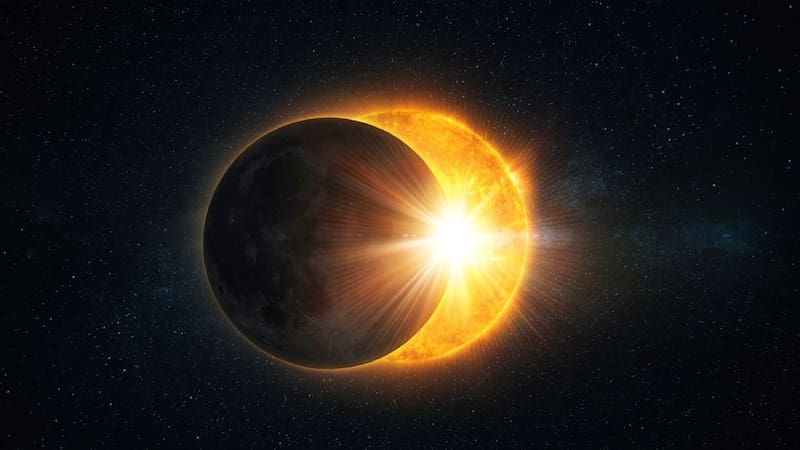
The 2027 astronomical calendar will feature a standout event: an annular solar eclipse that will occur on Saturday, Feb. 6, 2027 and form the so-called ring of fire, a phenomenon that happens when the Moon passes in front of the Sun but does not completely cover it, leaving a bright rim visible around its silhouette.

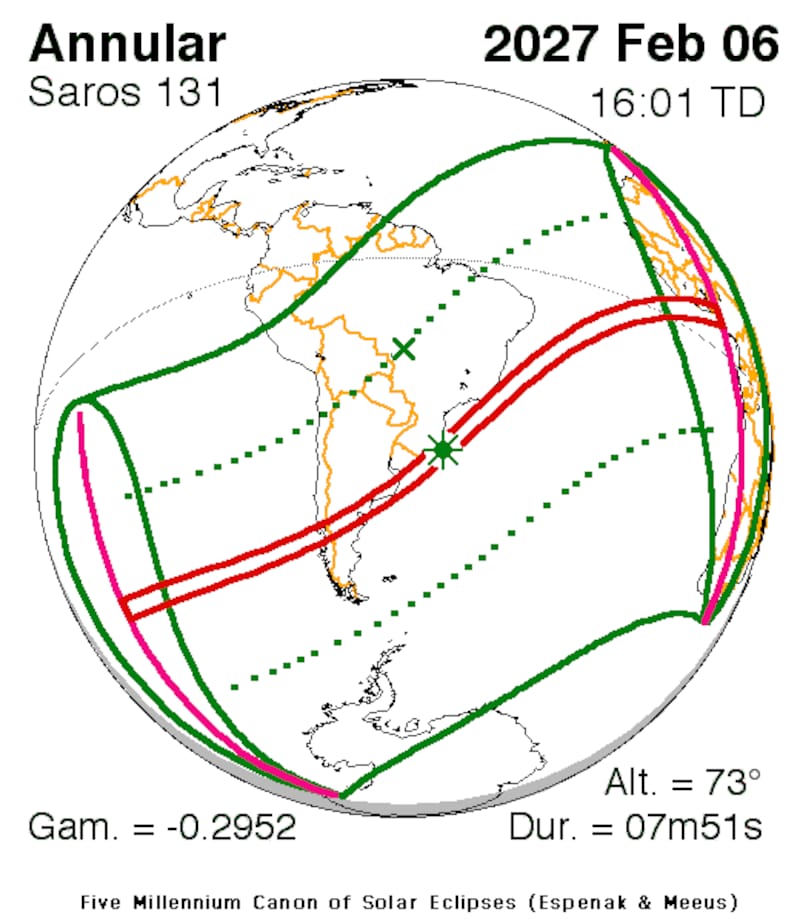
According to predictions published by NASA, the eclipse will reach its peak at 11:00 ET and will have a central duration of 7 minutes and 51 seconds. Its annularity path will be 282 kilometers wide, while the point of maximum obscuration will be located at 31.3 degrees south latitude and 48.5 degrees west longitude.
The phenomenon will also be visible in partial form from other regions within the eclipse’s visibility zone. NASA’s map shows its path across the Southern Hemisphere, with the central track crossing the Atlantic Ocean and areas near South America, including Argentina, Uruguay, Chile, and Brazil, as well as Africa. Full-ring visibility, however, will be limited to those within the narrow annularity path.

Eclipse calendar: the five astronomical events set for 2027
NASA is forecasting five eclipses in 2027: two solar and three lunar. The events will be spread between February and August, with two standout phenomena for those following the movements of the Sun and Moon. The astronomical calendar includes the following dates:
- Feb. 6, 2027: annular solar eclipse.
- Feb. 20, 2027: penumbral lunar eclipse.
- July 18, 2027: penumbral lunar eclipse.
- Aug. 2, 2027: total solar eclipse.
- Aug. 17, 2027: penumbral lunar eclipse.
That means February will open the season with two eclipses, while August will bring three more events. The year’s second solar eclipse, set for Aug. 2, will be total, unlike February’s annular event.
Feb. 6, 2027 solar eclipse: path, duration and features
The Feb. 6 eclipse is an annular solar eclipse. This phenomenon occurs when the Moon moves between Earth and the Sun, but because of its distance from the planet, it does not completely cover the solar disk. As a result, a luminous ring remains visible around the Moon, popularly known as the Ring of Fire.
According to NASA estimates, the event will have a magnitude of 0.92811 and a central duration of 7 minutes and 51 seconds. Its annularity path will be 282 kilometers wide, a measurement that refers to the crosswise width of the track, not the total distance the eclipse will travel. These are the main data released by the space agency:
- Date: Saturday, Feb. 6, 2027.
- Maximum eclipse (UT): 16:00.
- Maximum eclipse (TD): 16:00:48.
- Central duration: 7 minutes and 51 seconds.
- Eclipse magnitude: 0.92811.
- Width of the annularity path: 282 kilometers.
- Point of maximum obscuration: 31.3 degrees south latitude and 48.5 degrees west longitude.
- Sun altitude: 73 degrees.
- Saros series: 131, member 51 of 70.
As for its location, the visibility map published by NASA shows that the annularity path will cross the Southern Hemisphere, from areas near South America toward the South Atlantic Ocean and on to the African continent. The point of maximum obscuration will be over the Atlantic, off the southern coast of Brazil.
It is important to distinguish between the visibility of the annular eclipse and the partial eclipse: the ring of fire can only be seen from places within the central path, while other regions within the penumbral area will be able to see the Moon partially covering the Sun. The phenomenon will not be visible from Mexico, so the ring of fire will not be seen from the country.
NASA also explains that this event is part of Saros series 131, a system that groups eclipses with similar geometry. The agency says the Saros cycle lasts about “6585.3 days (18 years, 11 days and 8 hours).”
This means that eclipses belonging to the same series return with similar configurations after that interval, although they are not necessarily seen from the same places on Earth.