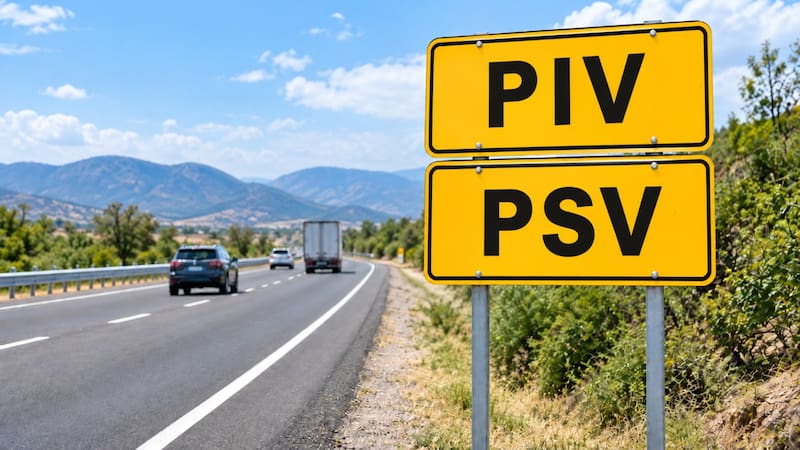

Mexican drivers traveling on a highway may come across signs with the abbreviations PIV or PSV. While they may seem like simple technical abbreviations to many, they actually contain important information about the road ahead.
These signs are common on highways and major avenues in Mexico and help drivers anticipate how the road will continue, especially when an overpass or underpass is approaching.
Knowing what they mean helps drivers proceed more carefully and prepare for changes that may come up on the road.
What do the PIV and PSV signs mean?
The abbreviation PIV stands for Paso Inferior Vehicular (Vehicular underpass). This sign indicates that the road you are driving on will pass underneath another road or structure. This could be an avenue, a bridge or even a railroad crossing. In other words, the road drops to pass below another level of traffic.
Its purpose is to warn the driver about the infrastructure ahead and allow them to anticipate changes in the road layout.
However, it is important to keep in mind that some underpasses have height restrictions that determine which vehicles can go through them. For this reason, it is common to see supplementary signs indicating the maximum permitted height.
While a passenger car usually has no trouble, this information is essential for trucks, buses, and other large vehicles.
PSV, on the other hand, stands for Paso Superior Vehicular. This sign indicates that the road will rise to pass over another road, an intersection, or some other obstacle. So when a driver sees this sign, they should expect an uphill stretch followed by a downhill stretch, depending on the design of the structure.
The difference between the two signs is easy to remember
It does not matter whether the structure looks like a tunnel, bridge, or viaduct. What determines its name is the position of the roadway in relation to the road or obstacle it must cross.
Driver precautions on Mexico’s highways
The PIV and PSV signs are part of traffic signage that can be found in both urban areas and on highways in Mexico. Just remember that the word inferior refers to a passage below, while superior means traffic will continue above another road.
Identifying these traffic signs early can make a difference while driving, as in the case of:
- Grades
- Ramps
- Access points
- Exits
- Specific restrictions for certain vehicles
That is why knowing what each sign is telling you lets you adjust your speed, keep a safe distance, and stay properly positioned in your lane.
In addition, during long trips, attention is often focused on traffic, nearby vehicles, or road conditions. In that context, taking a few seconds to read the signs can help prevent unexpected maneuvers.