
En esta noticia
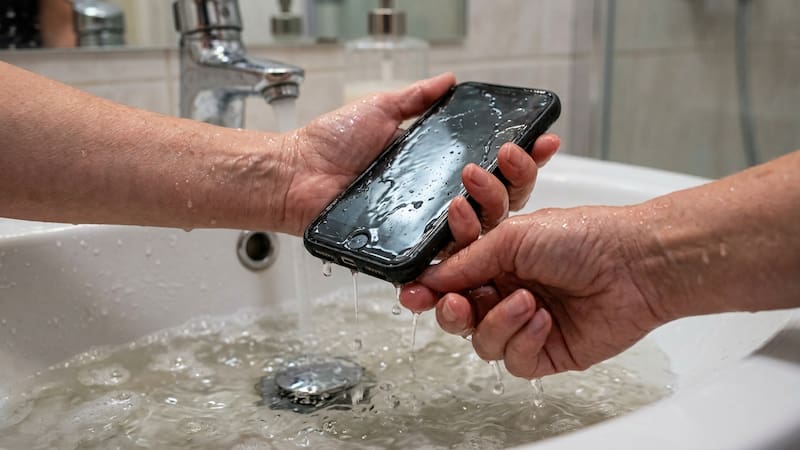
The accident happens in a second: the phone slips from your hands and ends up submerged in the toilet, the sink, or a puddle.
The immediate reaction is usually panic, followed by desperate attempts to check whether the screen turns on or to look for quick solutions on the internet.
However, acting without knowledge can sentence the device’s electronics to death.
Understanding the destructive processes triggered by the liquid and applying an immediate action guide based on laboratory tests are essential steps to save the device’s memory and components.

What happens to the cellphone when it falls into water?
When a cellphone falls into water, the main risk is that moisture reaches the internal electronic components while the device still has power. The liquid can enter through the charging port, speakers, microphone, slots, and other openings, and reach the logic board.
If the water reaches certain areas of the board, it can create electrical connections where none should exist and cause failures or short circuits. The risk increases if the phone remains on or is turned on after getting wet.
In addition, the problem does not end when the cellphone appears dry. Water contains minerals and impurities that can leave residues on the components and promote corrosion of the traces, connectors, and solder joints. That is why a phone may work normally after getting wet and begin to show faults hours or even days later.
The device’s architecture also affects how much liquid can enter and which components it reaches. Cellphones with a certain degree of water resistance have seals and protections designed to limit moisture entry, although that protection does not mean they are completely waterproof or that it remains intact throughout the device’s useful life.
Myths that do not work: the ineffectiveness of rice and false remedies
The habit of burying the cellphone in a container with raw rice traditionally is the most widespread urban belief for saving a wet device.
However, conventional rice is the least absorbent method of all available household alternatives, being unable to extract the moisture trapped in the deeper layers of the device.
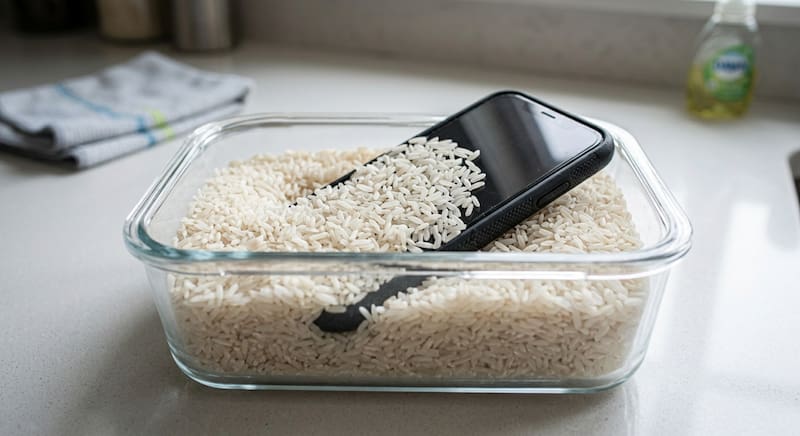
Worse still, the dust and starch released by the grains can enter through the charging ports and speakers, forming a paste that clogs and further damages the internal connectors. Leaving the phone enclosed in a container with rice limits air circulation, slowing the natural drying process.
Tests show that simply exposing the device to open air far outperforms the absorption capacity of conventional dry rice. Far from being mere theoretical speculation, the ineffectiveness of these homemade methods and the vulnerability of each type of device were exposed in a rigorous laboratory analysis.
Gazelle’s investigation into behavior in response to liquid absorption attempts
To verify the real effectiveness of popular remedies, specialist Scott S. Lyman and the team at the technology refurbishing company Gazelle carried out an experiment with nine smartphones destined for recycling.
During the test, they submerged five Samsung Galaxy S III models, three iPhone 4s, and one iPhone 3GS to analyze their behavior and recovery rate.
The results showed drastic differences according to each brand’s design:
- All Samsung Galaxy S III devices managed to turn on and work without aftereffects after the drying process, thanks to the fact that their removable battery cut the power in time and the open structure of their chassis allowed the water to drain out.
- Most iPhones suffered irreversible damage from corrosion and moisture buildup around the non-removable battery.
In a second test, the study compared the water absorption capacity over 24 hours among seven common materials: cat litter, couscous, traditional oats, instant oats, instant rice, silica gel, and conventional raw rice.
Raw rice turned out to be the worst option of all. However, the experiment showed that leaving the test object in the open air was more effective than any of the desiccants. Based on the data obtained in these tests with real devices, the experts were able to design a rapid-action protocol that maximizes the chances of survival.


Step by step: the emergency guide to rescue your device and how to dry it properly
After a fall into water, the speed of response in the first few minutes is crucial to save the phone’s memory and components. The emergency procedure recommended by specialists is divided into the following consecutive stages:
- Immediate shutdown and removal of components: Turn off the phone instantly without trying to press unnecessary buttons or check whether the screen works. Remove the case, SIM card, MicroSD memory card, and battery if the model is removable.
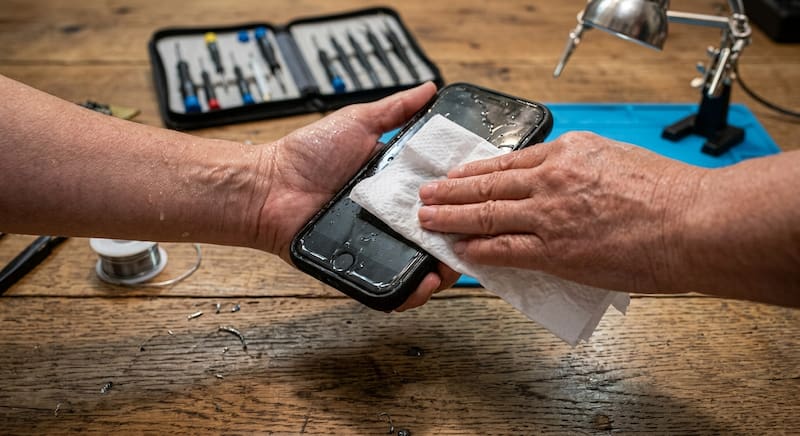
- Mechanical evacuation of the liquid: Dry the surface with absorbent paper towels. Shake the device firmly while keeping the ports facing downward, blow on it, or use a low-power vacuum over the openings to suck out as much surface water as possible.
- Opening the chassis (if you have tools): If possible, remove the chassis screws (using specific screwdrivers such as Pentalobe for iPhone or Phillips for Android) to expose the logic board directly to the air.
- Airflow drying or high-absorption desiccants: Place the device in a ventilated area in front of the continuous airflow of a fan. If choosing a drying agent, use only silica gel or instant rice in large quantities (at least 4 cups in a 1- to 2-liter container) for 24 to 48 hours.
Following this strict protocol and discarding myths without scientific basis makes it possible to minimize the risk of short circuits, protecting the logic board and extending the device’s useful life after a water accident.