
En esta noticia
The United States and Iran announced a preliminary agreement to end the war: the Strait of Hormuz will reopen, and both countries will have 60 days to negotiate the key issues, including Iran’s nuclear program.
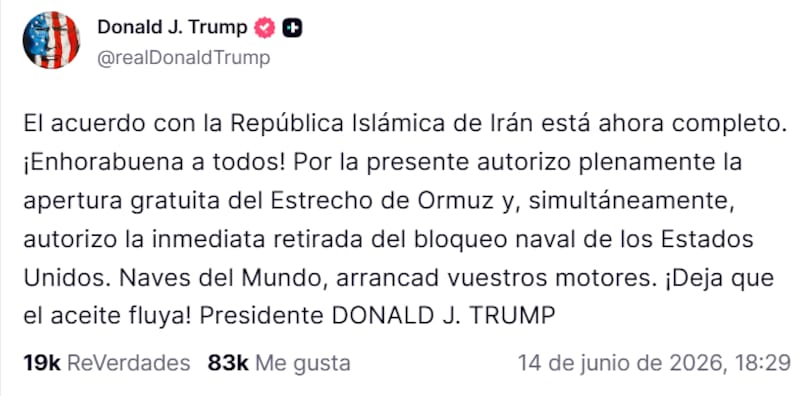
“The agreement has already been signed,, and the strait has already been partially opened”, Trump said this Monday upon arriving in France for the G7 summit.
The memorandum was signed electronically by Trump and his vice president, JD Vance; on the Iranian side, it was signed by the speaker of parliament, Mohammad Bagher Ghalibaf. The official ceremony is scheduled for Friday, June 19, in Geneva, Switzerland.
The conflict, which began on February 28 with joint attacks by the United States and Israel against Iran, left perhaps at least 7,000 dead, mostly in Iran and Lebanon, according to the Human Rights Activists News Agency in Iran (HRANA), based in the United States
The closure of the Strait of Hormuz by the Islamic Republic, through which roughly one-fifth of the world’s oil supply flows, unleashed the most severe energy crisis in decades.
What the U.S.-Iran agreement says and what remains unknown
The memorandum —one page and 14 points, according to Pakistani officials cited by the AP— sets as a starting point the simultaneous reopening of the Strait of Hormuz and the lifting of the U.S. blockade on Iranian ports.
From there, both sides will have 60 days to negotiate the substantive issues, with the possibility of an extension if progress is made.
The confirmed commitments so far include:
- Reopening of Hormuz without tolls, according to Trump, thereby reversing Iran’s demand to impose a fee on transiting ships
- Gradual lifting of sanctions on Iran, conditioned on progress in the negotiations
- A $300 billion reconstruction fund, financed by Gulf allies, according to U.S. officials cited by Reuters
However, the full text of the agreement has not yet been published. Trump’s administration promised to release it before Wednesday.
For now, several questions remain open —and are central—:
What will happen to Iran’s ballistic missile program?
What will happen to its support for militias such as Hezbollah in Lebanon or the Houthis in Yemen? Something that Israeli Prime Minister Benjamin Netanyahu thanked Trump for including in last week’s negotiations.
How will the situation in southern Lebanon be resolved, where Israel keeps troops deployed and where the conflict with Hezbollah did not fully cease with the announcement?
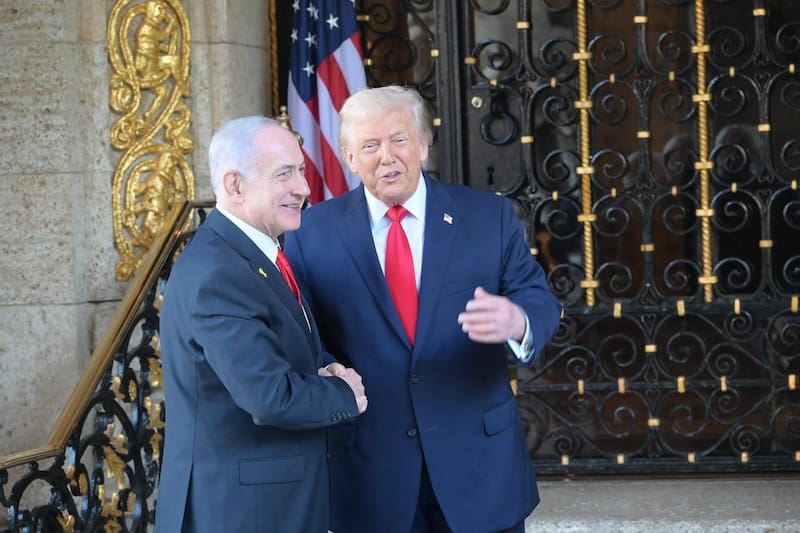
Iranian Foreign Minister Abbas Araghchi demanded this Monday that Israel immediately stop its attacks in Lebanon. Netanyahu, for his part, said Israel will keep its forces in southern Lebanon and reserves the right to respond to Hezbollah attacks. “Iran wanted us to withdraw, but I stood firm”, he said that same Monday at a press conference.
It is also unclear what will happen to the 440 kilos of uranium that Iran has enriched to almost the level needed to build a nuclear weapon. According to the Financial Times, during the negotiations, Iran agreed to discuss its dilution or handover, but it has not been confirmed whether that point was included in the final text of the memorandum.
Why Trump needed this agreement
When Trump launched the war on February 28, he promised a swift and decisive victory: dismantling Iran’s nuclear program, destroying its missile arsenal, promoting regime change in the Islamic Republic, and cutting off support to its regional militias.
According to the New York Times, when Israel proposed the surprise joint attack, Netanyahu described to Trump a scenario in which they would destroy Iran’s missile program, weaken the regime, and trigger a popular uprising that would topple it. None of that happened.
What did emerge over the course of the 107 days of attacks and negotiations was a surge in political and economic costs that made the continuation of the conflict practically unsustainable.
The annual inflation in the United States rose from 2.4% in February to 4.2% in May, recording its highest inflation reading in two years.
A gallon of gasoline went from $3.13 a year ago to $4.07 this week. Strategic oil reserves fell to 340.3 million barrels, their lowest level since 1983, after the release of 172 million barrels ordered by Trump in March to offset the shortage.
The impact of the war on the U.S. president’s approval was direct. His approval rating stands at 36%, near the lows of his political career, according to a Reuters/Ipsos poll published this Monday. Only 24% of Americans approve of his handling of the cost of living.
With the midterm elections scheduled for November 3, Republican candidates face an unfavorable scenario: registered voters prefer Democratic candidates by 41% to 38%.
The split within the Republican Party itself added another layer of pressure. Non-interventionist factions saw the war as a betrayal of Trump’s promises not to launch new conflicts. On the other hand, the president’s more hawkish allies wanted to go further militarily and have already expressed their disappointment with the agreement. According to the FT, Senator Lindsey Graham said he was “somewhat concerned” because the Iranian view of the pact “seems different” from the one presented by the U.S. negotiating team and called for Congress to review it.
The relationship with Israel added another complication. Netanyahu, who had presented the joint operation as an unprecedented alliance, was progressively sidelined from the negotiations. The Israeli leader acknowledged this Monday that he and Trump “do not always agree,” although he defended the relationship.
However, according to Reuters, Israeli officials privately said that the agreement is “terrible for Israel”. Trump himself acknowledged last week in an interview with Fox News that the United States does not have the ‘stomach’ for a larger escalation.


Markets react, but normalization will take time
Confirmation of the agreement had an immediate effect on energy markets. Brent crude fell 4.76% on Monday to $83, its lowest level in three months. West Texas Intermediate (WTI), the U.S. benchmark, fell 4.87% to $80.75.
Trump said the strait is already partially open and he expects it to be fully operational by Friday, once the operation to remove all the mines Iran placed in the strait is completed.
Analysts agree that, although the direction is bearish for crude prices, full normalization of the oil market will not be immediate.