

En esta noticia
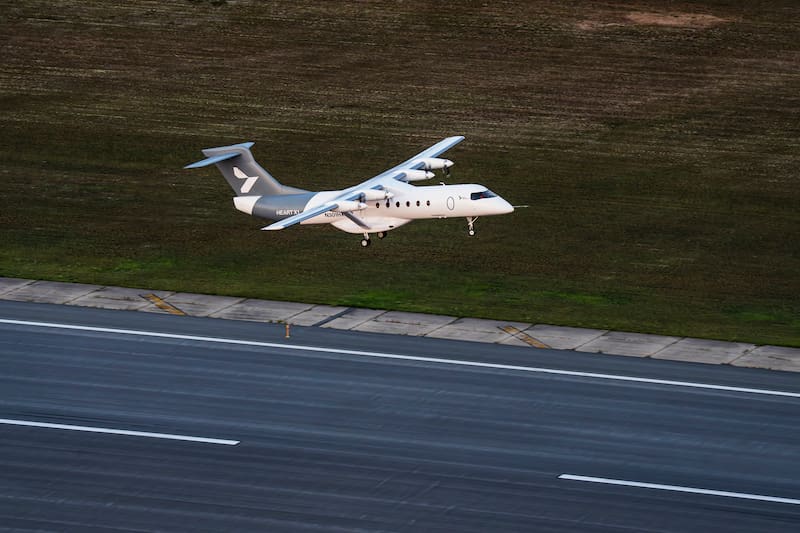
The aviation industry took another step toward electrification with the first flight of the Heart X1, the largest battery-electric airplane ever to take off, which lifted off last Wednesday, Aug. 12, 2026. The prototype from U.S. company Heart Aerospace spent 27 minutes in the air during a test in New York, where its systems were evaluated and its ability to carry out different maneuvers was assessed.
The aircraft has a 32.3-meter wingspan, four electric motors and a propulsion system powered exclusively by batteries. Its first flight marks a breakthrough in the development of technologies that aim to reduce reliance on conventional fuels and open new possibilities for regional aviation.
The project is also part of a more ambitious plan centered on developing a hybrid-electric aircraft with capacity for up to 30 passengers. While the company moves ahead with testing the X1, it is working on the future ES-30, a model it hopes will bring this technology to commercial transport.


What the First Flight of the Heart X1, the World’s Largest Electric Airplane, Was Like
The Heart X1 completed its flight at Plattsburgh International Airport in New York state, United States. The aircraft stayed in the air for 27 minutes, reached an altitude of 1,100 feet and carried out various maneuvers to verify its behavior under real flight conditions and the performance of its propulsion system.
The test included taxiing on the runway, takeoff, climb, airborne maneuvers and landing, where, according to Heart Aerospace, the electric system delivered more than 1 megawatt of power during the trial. The flight was conducted with a pilot on board and under a special authorization from the U.S. Federal Aviation Administration (FAA) for experimental aircraft.
What Are the Features of the Heart X1 Electric Airplane?
The prototype has a 32.3-meter wingspan, a length of about 23.2 meters and a weight of more than 11,350 kilograms at takeoff. One of its main features is that it has four electric motors mounted on the wings, powered exclusively by batteries.
The X1 is built at full scale rather than as a reduced model for lab testing, since its design makes it possible to evaluate how key parts of an electric aircraft work together, such as the batteries, motors, power electronics, flight controls and navigation systems. It also serves to study aerodynamic performance and gather information on how it behaves during different phases of operation.
What Commercial Airplane Does Heart Aerospace Plan to Develop After the X1?
The company’s goal is to use the results from the X1 to move forward with the development of the ES-30, a hybrid-electric regional aircraft designed to carry up to 30 passengers. Unlike the prototype, this model will combine electric motors with conventional engines, so it can use battery power on certain routes and rely on hybrid propulsion to cover longer distances. In this sense, the company projects a range of up to 200 kilometers in fully electric mode and about 800 kilometers in hybrid configuration, according to the manufacturer’s current specifications.
Heart Aerospace aims for the ES-30 to be certified and enter commercial service in 2031, but before reaching that stage, it must complete new rounds of construction, flight testing and safety evaluation. The company expects to begin flight tests of the model in 2028.
It should be noted that it is still under development, and the X1’s first flight does not mean the commercial plane is already ready to carry passengers.