
En esta noticia
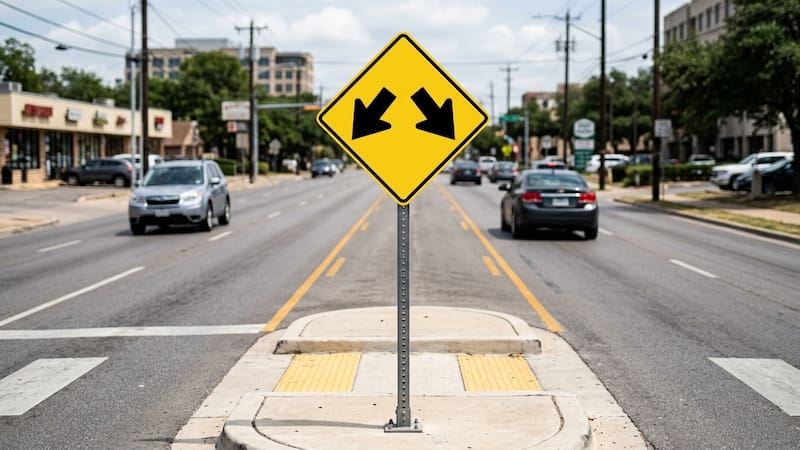
Some traffic signs in the United States can be somewhat unintuitive for those who are not familiar with the North American road system. Among them is a rectangular sign with two black arrows pointing downward, which appears at certain points on the roadway to guide traffic around an element located in the road.
This sign is part of the MUTCD, the federal manual that sets criteria for the signs, markings, and other devices used on U.S. streets and highways.
Identified as W12-1, “Double Arrow,” it has a specific indication for those traveling on the road, and understanding it makes it possible to correctly interpret the signage at the location and know how to continue when it appears in front of the vehicle.

What does the traffic sign with two black arrows pointing downward mean?
The W12-1 sign, known in the United States as “Double Arrow”, means that there is an obstruction, traffic island, or roadway divider ahead and that vehicles may pass on either side. The sign is part of the Manual on Uniform Traffic Control Devices (MUTCD), which establishes the national standards for signage and other traffic control devices.
The two arrows pointing downward represent the two traffic options available to get around the element located on the road, so the sign does not indicate that the driver must necessarily take the right or left side.

What should the driver do when finding the traffic sign with two black arrows pointing downward?
When encountering this sign, the driver must continue along one of the two permitted sides to get past the obstruction or divider, but the choice will depend on the configuration of the roadway and on the other traffic signs and road markings present at the location.
Where can this W12-1 “Double Arrow” traffic sign appear?
The MUTCD establishes that the W12-1 may be used on a traffic island, in front of an obstruction, or in front of a roadway divider when traffic can travel on both sides of the element.

When placed on an island, the sign is located near the end from which traffic approaches, but if it is used to warn of an obstruction, the traffic sign may be installed on it or immediately in front of it, according to MUTCD specifications.