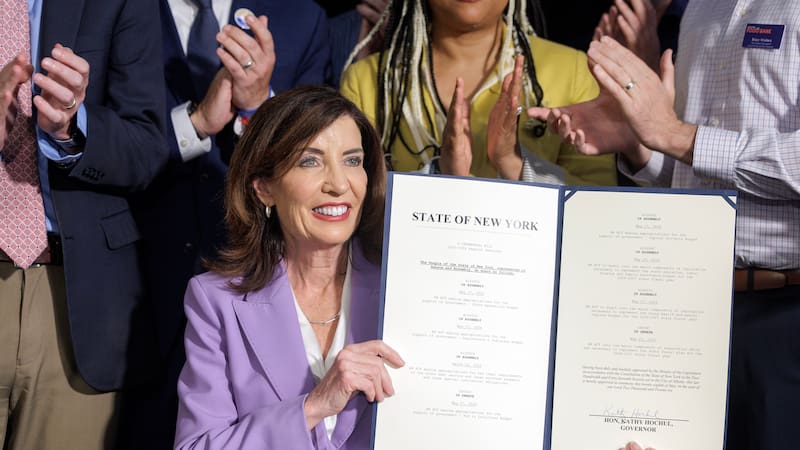

On Thursday, May 28, Governor Kathy Hochul signed her Fiscal Year 2027 Budget, which, according to the proposal, will make New York more affordable and safer for its residents, while also expanding opportunities for everyone.
The budget includes far-reaching measures aimed at reducing residents’ spending. From steering the state toward universal child care to lowering utility costs and delivering energy rebate checks.

The main economic and social measures included in the fiscal plan
“Every proposal included in this Budget represented a fight for New Yorkers and their future, ” said Governor Hochul.
Health: the area that consumes the most resources in the state budget
Health remains the state’s largest spending area in New York. For fiscal year 2027, the budget projects spending of $38.167 billion for Medicaid, up from $34.273 billion in the previous year. This represents an increase of $3.894 billion, equivalent to 11.4%, the largest increase among the major state spending categories.
Several simultaneous factors drive the program’s growth. The government identifies among them rising medical costs, more expensive drugs, the expansion of benefits approved in recent years, and growing demand for long-term care services for older adults.
Currently, more than 6.8 million residents receive coverage through Medicaid. If other public programs such as Child Health Plus and Essential Plan are added, the total reaches 9.1 million people, making New York the state with the highest share of residents covered by public health insurance.
The budget also notes that New York offers one of the broadest coverage systems in the country. State spending per beneficiary reaches $4,755 annually, well above the national average of $2,657 and also higher than that of the second-highest-spending state per capita, Kentucky.
The Hochul administration believes health care will remain one of the most sensitive areas at risk of federal cuts. For that reason, the budget preserves resources to ensure continuity of coverage and avoid reductions in essential services for millions of New Yorkers.
Education: a record investment surpassing $39 billion
Education is once again among the state’s top budget priorities. For the 2026-2027 school year, New York will allocate $39.253 billion to school aid, an increase of $1.627 billion compared with the previous year.
Most of these resources go to Foundation Aid, the main funding mechanism for public schools. The budget includes a $779 million increase for this item and maintains the state administration’s commitment to sustaining full funding of the formula.
New York continues to lead the national ranking in education spending per student. According to the data included in the budget, in 2023, the state invested $30,012 per student, more than 80% above the national average of $16,526.
Public safety: more resources for prevention, technology and emergency response
Public safety is one of the standout priorities of the FY2027 budget. In addition to the operational investments previously announced by the Hochul administration, the financial plan includes new line items aimed at strengthening security infrastructure, improving emergency response capacity, and expanding crime prevention programs.
Among the most important investments is a 50 million allocation to complete the new State Emergency Operations Center. This facility will serve as the main coordination center for natural disasters, large-scale emergencies, and situations requiring joint intervention by multiple public agencies.
The budget also sets aside $50 million for the adoption of new police technologies. The funds will make it possible to modernize equipment, strengthen investigative capabilities, and expand tools used by state and local law enforcement agencies.
Another significant item allocates $35 million to the Securing Communities Against Hate Crimes program. This initiative funds protection measures for religious organizations, educational institutions, community centers, and other entities considered potential targets of hate- or discrimination-motivated crimes.
The government also reserved $10 million to strengthen the security of reproductive health centers. The resources may be used for building improvements, surveillance systems, and other measures designed to protect medical facilities from threats or acts of violence.
According to the state administration, these investments are part of a broader strategy that combines prevention, technological modernization, and institutional strengthening to address the security challenges facing the state.
Environment, water and climate resilience
Environmental protection holds an important place within the capital investment program for the coming years. The budget establishes a commitment of $3.75 billion over five years for water infrastructure projects, equivalent to $750 million per year.
These resources will be used to modernize drinking water systems, renew distribution networks, improve wastewater treatment facilities, and fund the work needed to meet increasingly demanding environmental standards.
The Hochul administration argues that many communities face challenges related to aging water infrastructure, which is why it considers it a priority to accelerate investments aimed at ensuring safe and reliable services.
The budget also maintains the highest level of funding in history for the Environmental Protection Fund. The program will receive $2.1 billion distributed over five years, equivalent to $425 million annually for environmental projects across the state.
The funds will support conservation of natural spaces, ecosystem restoration, water quality programs, coastal protection, climate resilience, and improvements to parks and recreational facilities.
Energy and affordability: lowering costs for households
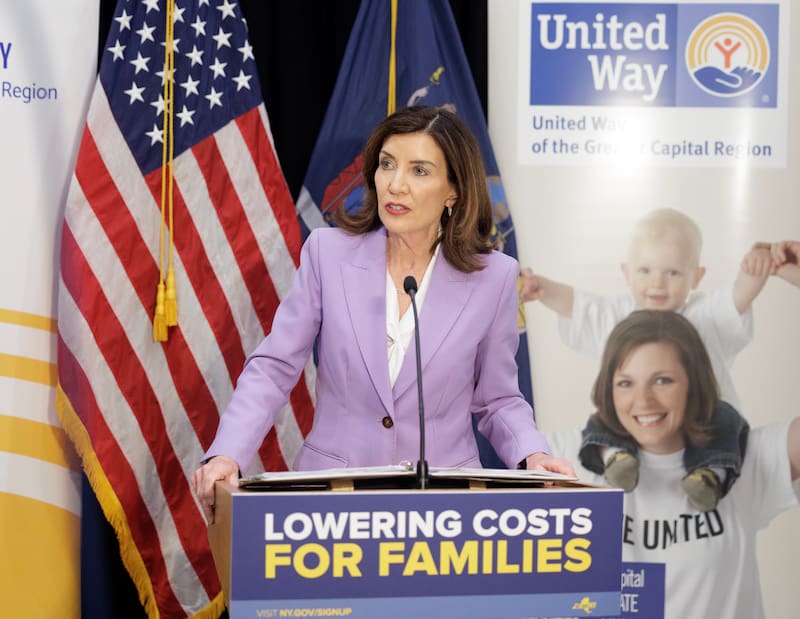
Affordability was one of the most frequently repeated concepts by the Hochul administration during the budget presentation. On energy matters, the government seeks to reduce the pressure that utility bills place on millions of households.
One of the most visible measures is the POWER program, which provides direct payments to eligible taxpayers. Couples with incomes up to $150,000 will receive $200, while those with incomes between $150,000 and $300,000 will receive $150.
The budget also includes regulatory measures aimed at strengthening oversight of utility companies and improving consumer protection against increases deemed excessive in energy costs.
The administration maintains that energy is one of the main economic concerns for families, especially after increases in various services in recent years.
The measures are part of a broader strategy of economic relief that includes tax credits, assistance programs for working families, and support for sectors particularly affected by the rising cost of living.
According to the state government, the goal is for benefits to reach both middle-income households and vulnerable families that devote a significant share of their income to paying for essential services.

Protection for immigrants and consumers
The budget includes various measures intended to protect populations considered especially vulnerable, including immigrant communities and consumers against abusive or discriminatory practices.
On immigration matters, the government reaffirms access to essential services such as education, health care, community assistance, and state-funded social programs. The administration argues that these policies are intended to ensure residents can access basic services regardless of immigration status.
The financial plan also maintains restrictions on the sharing of certain personal data with federal authorities, except in cases provided for under current law. These provisions are part of the state policy for protecting immigrant communities.
In consumer protection, the budget toughens measures against insurance fraud and expands regulatory powers to oversee insurance companies operating in the state.
One of the most relevant reforms limits the use of certain personal factors to set insurance rates without prior authorization from the Department of Financial Services.
According to the Hochul administration, these measures seek to increase transparency in the insurance market, reduce discriminatory practices, and protect consumers from unjustified cost increases.
Housing: speeding up construction and tackling the housing crisis
Housing is one of the central pillars of the FY2027 budget due to the sharp increase in rents and purchase prices recorded in recent years. The Hochul administration argues that the lack of housing supply has become one of the main factors driving the cost of living in New York.
The budget funds the final stage of the state $25 billion housing plan aimed at creating or preserving 100,000 affordable homes across the state. That goal includes 10,000 units with supportive services for vulnerable people, older adults, people with disabilities, and residents facing housing instability.
According to official data, more than 70,000 homes have already been created or preserved since the program was launched, so the government believes it is on track to meet the original target.
In addition, $250 million is allocated to accelerate new residential developments through construction incentives and the reduction of regulatory barriers. The goal is to increase the speed at which housing projects reach the market.
Another focus is technological innovation applied to construction. For this purpose, $100 million is allocated to promote modular construction systems and other methods that can reduce costs and construction times.
The budget also includes $1 billion for the City of Yes for Housing Opportunity program, an initiative that seeks to facilitate the development of new housing through urban planning reforms and zoning changes that allow greater residential density in certain areas.
Transportation and infrastructure: $107 billion to modernize the state
Infrastructure represents one of the largest capital investments included in the budget. The state plan foresees $107 billion in investments over the next five years to fund transportation projects, connectivity, and public works.
One of the most ambitious projects is the Hudson Tunnel Project, which will receive $15.8 billion for the construction of a new rail tunnel under the Hudson River. The project seeks to replace critical infrastructure connecting New York and New Jersey and improve one of the country’s busiest rail routes.
The metropolitan transit system also accounts for a significant portion of the investment. The MTA Capital Plan for 2025-2029 will have $68.4 billion dedicated to station modernization, track renewal, rolling stock purchases, and operational improvements.
In aviation, the budget maintains the comprehensive transformation of John F. Kennedy International Airport through a project valued at $19.5 billion. The initiative aims to modernize terminals, improve access, and expand the operating capacity of the state’s main international airport.
The Department of Transportation will also manage a five-year $34.4 billion plan for roads, bridges, and transit systems. Within this package, $1 billion is included for the Bridge NY program and another $1 billion for the Pave Our Potholes program, aimed at repairing streets and highways.
Authorities say these investments will not only improve mobility for millions of people but also boost job creation and economic growth in different regions of the state.
Child care and early childhood: one of the main social bets
The budget allocates $4.5 billion to the child care system and early education, consolidating one of the largest state investments made to date in this area.
Within that figure, $2.2 billion is included to expand access to subsidized child care programs, a measure aimed at reducing costs for working families and expanding coverage for low- and middle-income households.
The government also plans $1 billion to create new slots for children under age four, to reduce waiting lists, and increase service availability in regions where supply is insufficient.
In addition, $500 million is allocated to strengthen the state’s early education network, including community centers, private providers, and organizations that offer child care and development services.
The budget includes new initiatives such as the 2-Care NYC program, the expansion of Universal Pre-K, the strengthening of 3-K programs, and various pilot projects aimed at expanding the supply of child care services in different counties.
Economic development and agriculture: support for strategic industries and rural communities
The budget aims to strengthen sectors considered key to the state’s future competitiveness. These include advanced technology, manufacturing, the semiconductor industry, and activities linked to scientific innovation.
One of the most important programs allocates $85 million for the development of semiconductor design and quantum technology centers. The measure is part of the state’s strategy to position New York as one of the country’s leading technology hubs.
The Rochester area will receive $225 million for regional economic development projects aimed at attracting investment, creating jobs, and strengthening local productive sectors.
Likewise, the budget includes $300 million for the POWER UP program, intended to support industrial projects and technological innovation considered strategic for the state economy.
Rural areas are also part of the growth strategy. The government will allocate $750 million to regional economic development programs and support for rural communities facing challenges related to employment and productive activity.
The agricultural sector includes $15 million for the modernization of the dairy industry and $2 million for biotechnology projects related to industrial hemp, two activities considered priorities for rural economic diversification.