
En esta noticia
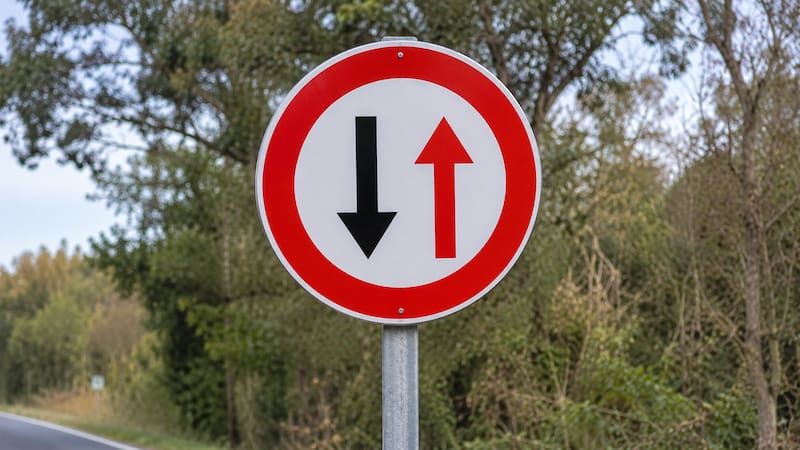
When driving on secondary roads or narrow streets, it is common to encounter stretches where two vehicles cannot pass each other at the same time. There, you may sometimes see a circular sign with a red border and two facing arrows, one red and one black, which many drivers notice without really knowing what it means. It is the R-5, and recognizing it helps avoid backups and dangerous situations on the road.
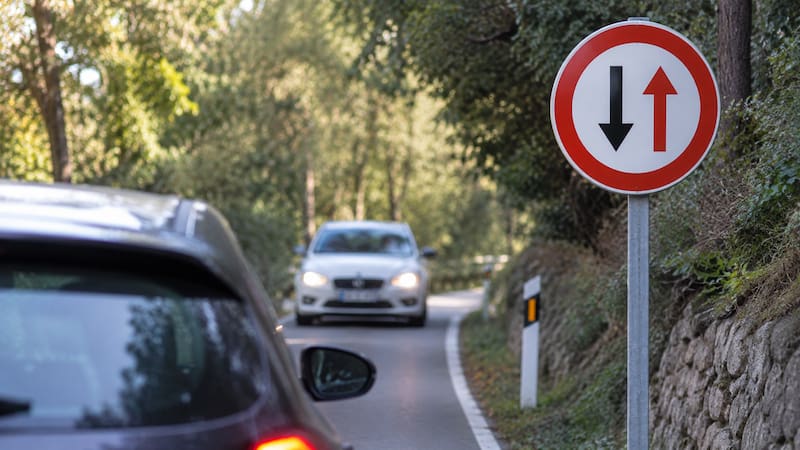
This sign means that whoever encounters it must yield to oncoming vehicles before entering. The red arrow represents the driver’s direction, and the black arrow represents the opposite direction, which has the right of way. You do not always have to stop, since if the stretch is clear and you can cross without affecting anyone, you may keep going.
When there are no signs, the General Traffic Regulations set the right of way by another rule.

How to read the arrows on traffic sign R-5
If traffic in both directions cannot pass at once, the driver who encounters the R-5 is the one who must wait. RACE also warns that it is forbidden to enter a narrow passage if doing so forces oncoming vehicles to stop.
Its counterpart is R-6, a square sign with a blue background and one white arrow and one red arrow, which gives priority over oncoming vehicles. Even so, you must check that the passage is clear and wait if another vehicle is already in the narrow section.
Who goes first if there are no signs
Article 60 of the General Traffic Regulations says that in stretches where the narrowness makes it impossible or very difficult for two vehicles to pass at the same time, the vehicle that entered first has the right of way, unless the signs say otherwise.
If it is not clear who arrived first, the vehicle with the greater difficulty maneuvering goes first. When one vehicle has to back up, the rule sets an order by vehicle type, with special vehicles and vehicle combinations near the front, and motorcycles and bicycles at the end.
What to do when you encounter the R-5 sign
When you reach the sign, the first thing to do is look at the stretch ahead. If no one is coming toward you and the way is clear, you may cross without stopping. If a vehicle is already in the narrow section or about to enter it, you must wait for it to finish passing.
The key is not to force anyone to brake or back up. Entering a narrow passage and forcing oncoming traffic to stop is prohibited. With the R-6 counterpart, which gives priority, the same caution applies: before moving forward, you must make sure the way is clear.
Special cases and penalties
The rules change when the narrowing has a grade of more than 7 percent. In that case, the DGT says the ascending vehicle has the right of way, and if there is a pull-off area nearby, it should be used to let the descending vehicle pass.
In a work zone, drivers must follow the instructions of the traffic controllers. Violations of these signs are considered serious and carry a 200 euro fine.