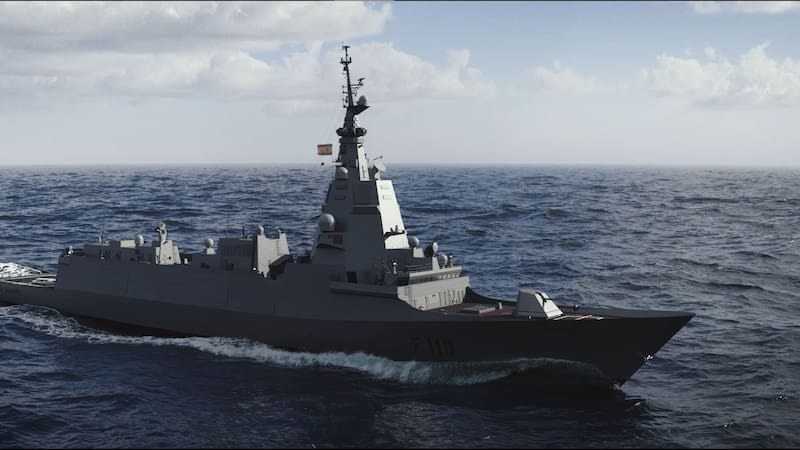

The Spanish Navy, working with Navantia, plans to add a new generation of the F-110 frigate with greater air defense and missile defense capability. The project, known as F-110 IAMD, builds on an evolution of the Bonifaz class and aims to protect a naval force against cruise and ballistic missiles.

The new frigate will have up to 64 vertical launch cells, according to the configuration Navantia presented in August at Denmark’s DALO Industry Days, compared with 16 on the five F-110 frigates under construction.
More cells and more size
The 64 cells are split between 48 in the bow and 16 in the aft superstructure. That is 16 more than the 48 Mk 41 cells on the Navy’s F-100 frigates.
The length would increase by about five meters to 150, and displacement would be around 6,700 tons.
Upgraded radar and combat system
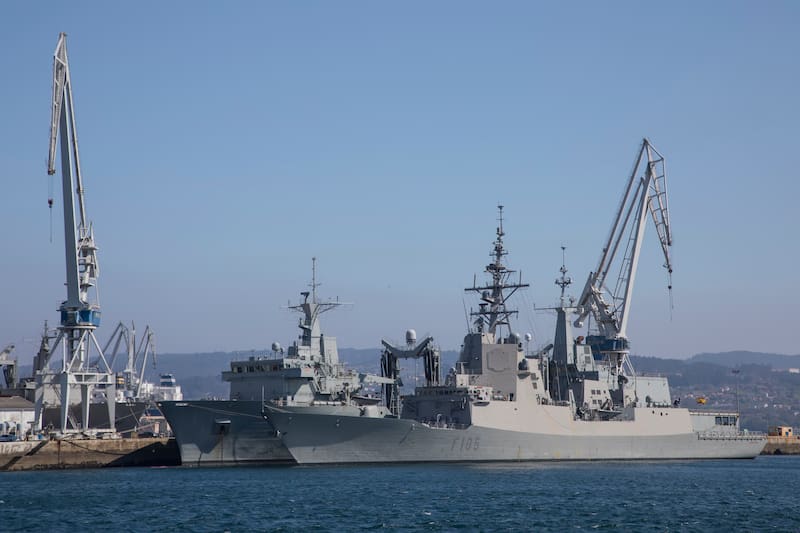
The new frigate will have a more powerful version of Lockheed Martin’s AN/SPY-7 radar, with greater ability to track multiple aerial targets. It will also feature an evolved Scomba combat system, with cloud architecture, to integrate sensors, weapons, autonomous systems, and data links.
It keeps the antisubmarine, anti-surface, and electronic warfare capabilities of the original family.
More weapons
The concept includes eight NSM anti-ship missiles in two quadruple launchers and 127-millimeter Leonardo gun and counter-drone systems. It also leaves space on both sides for directed-energy weapons.
The original F-110 was designed as a multimission escort with strong antisubmarine capability. The new version places much greater emphasis on air and missile defense.