
En esta noticia
Mexico continues to advance in the development of mobility friendly to the environment, from both the public and private sectors.
To already known projects such as the TT01, an electric vehicle designed for neighborhood mobility, or the Olinia prototype, already presented by the government, a new proposal developed by Mexican academic institutions.
A vehicle that runs on a hydrogen fuel cell
The Center for Research and Advanced Studies of the National Polytechnic Institute (Cinvestav) unveiled the Hidrobinisa, a small 100% electric vehicle that runs on a hydrogen fuel cell.
This means that the car moves thanks to the electricity stored in its lithium-ion batteries, which comes from the reaction of hydrogen with other chemical elements. With this technology, the vehicle can reach a maximum speed of 33 km/h for 90 to 100 minutes.
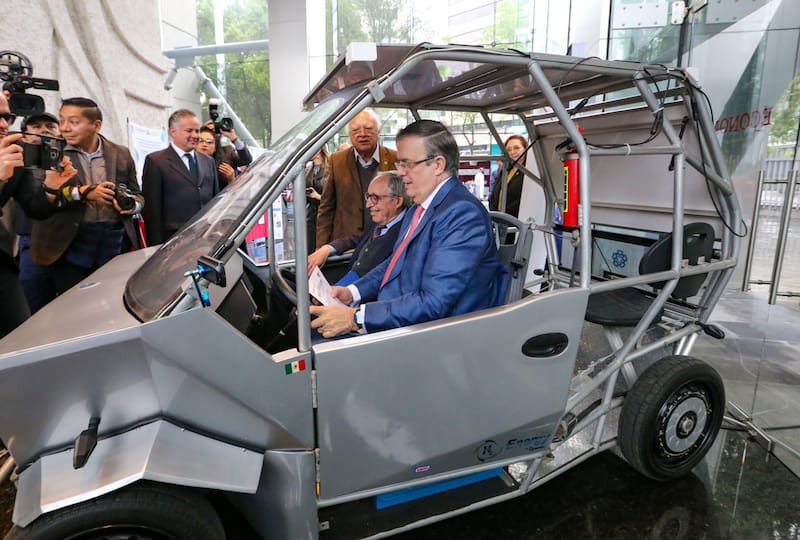
According to the plan, these capabilities could be used to transport people in hotels, tourist routes, study fields, or farms.
This is not the first time this technology has been used
Although this is an interesting project that has put Mexican scientists to work, this technology is not new worldwide. Toyota had already incorporated it into a mass-production vehicle, the Mirai, although the model was ahead of its time, since hydrogen refueling stations are not as common as fossil fuel stations.
Added to this are two other major challenges: the production of hydrogen itself, which remains a complex process, and the space required to store it inside a vehicle.
Despite these limitations, projects like the Cinvestav one show other possible applications for this technology within mobility, especially in short and low-speed trips, where its use could prove more viable.