
En esta noticia
Jordan has officially launched a megaproject to confront its drinking water shortage with infrastructure that will draw water from the Gulf of Aqaba in the Red Sea, desalinate it and transport it to Amman and other parts of the country. The plan calls for a $6.6 billion investment and is expected to begin supplying water by the end of 2030.
The project, known as the National Water Carrier Project, will have the capacity to produce 300 million cubic meters of drinking water per year.
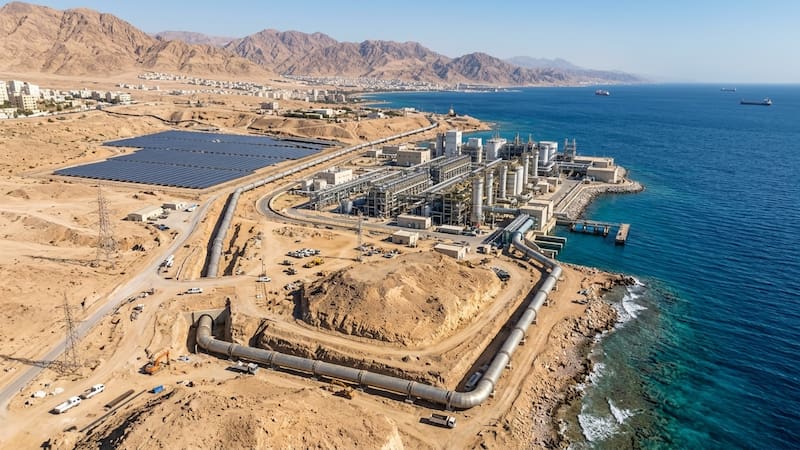
The system will include a desalination plant, an extensive underground pipeline and a solar power facility to supply part of its operations.


Jordan looks to fight water shortages with a project linking the Red Sea to its capital
Jordan faces a severe shortage of water resources and needs to expand its supply sources to meet the population’s demand. In that context, the government is pushing the National Water Carrier Project, which will use water from the Gulf of Aqaba to produce drinking water through a desalination process.
According to official figures, the plant will be able to produce 300 million cubic meters of drinking water a year, with 250 million cubic meters going to Amman, the capital, and the remaining 50 million supplying Aqaba. In this regard, the government estimates the project will cover about 40% of Jordan’s drinking water needs.
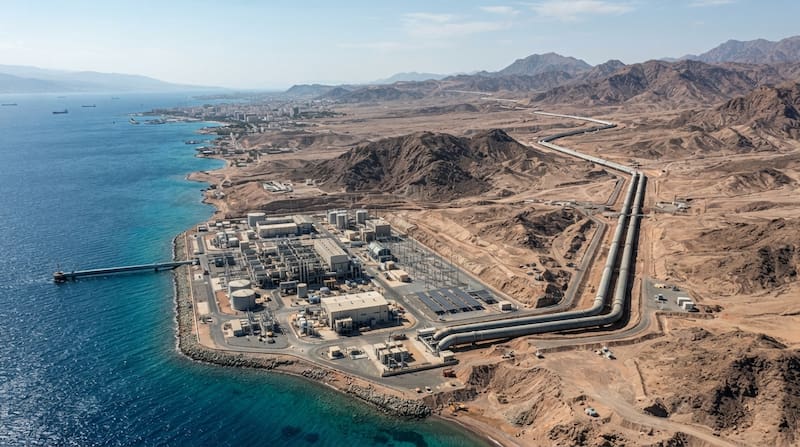
An underground pipeline will carry the water from the coast to cities hundreds of kilometers away
The system will begin by drawing water from the Gulf of Aqaba and then treating it at a desalination plant. Once it is turned into drinking water, it will be carried through an underground pipeline network to distribution points. The official announcement of the project’s launch, made on Nov. 18, 2026, said the pipeline will stretch about 417 kilometers.
The infrastructure will have to overcome a major geographic challenge, as the water must be pumped from the coast to areas located at elevations of up to 1,100 meters above sea level. To provide part of the energy the system will need, the project also includes a solar plant of about 300 megawatts.
The project has been officially launched, and water supply is expected to begin by the end of 2030
The project will be developed by a consortium led by French company Meridiam as the main developer, with SUEZ as technical partner and operator. The initiative has the backing of international financial institutions, including the European Bank for Reconstruction and Development (EBRD) and the Asian Infrastructure Investment Bank (AIIB). It will be carried out under a build-operate-transfer model, under which the infrastructure will later become the property of the Jordanian state.
The official launch took place on Nov. 18, 2026, in Aqaba, with the participation of Faisal bin Al Hussain. On that occasion, officials said the total investment amounts to 4.68 billion Jordanian dinars, equivalent to about US$6.6 billion. The timeline also calls for water supply to begin by the end of 2030.