
En esta noticia
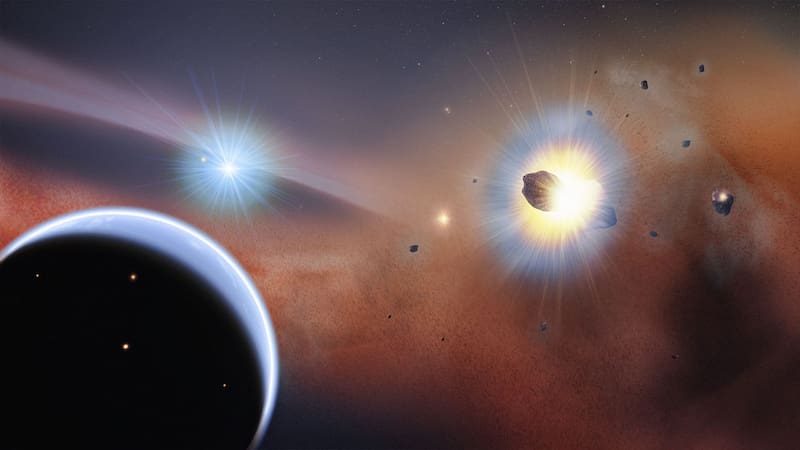
A group of astronomers attributed radio signals to a planet outside the Solar System for the first time. It is Beta Pictoris b, a giant exoplanet located 63.4 light-years from Earth.
The discovery was made by researchers from the Harvard & Smithsonian Center for Astrophysics and the University of Oregon, using the MeerKAT radio telescope in South Africa. The work was published on arXiv and is a preliminary study, pending peer review.

How long the observation lasted and what the experts detected
During four sessions carried out between 2025 and 2026, the team recorded a persistent emission and brief radio bursts at frequencies between 0.85 and 3.5 gigahertz. The waves showed strong circular polarization, a characteristic associated with auroral emissions and strong magnetic fields.
The authors noted that, although these bursts are observed on planets in the Solar System and in some ultracool dwarfs, no radio detection had previously been located unambiguously on an extrasolar planet and not on its host star.
How they confirmed the origin: what was the biggest challenge
The challenge was to rule out that the emissions came from the star Beta Pictoris. To do this, the astronomers used distant quasars as references in the sky, which made it possible to locate the source next to the planet and separate it from the star.
The data point to a natural emission generated in the planet’s magnetosphere. They are not related to extraterrestrial life or artificial communications.
A magnetic field stronger than Earth’s
The proposed explanation is electron cyclotron maser instability (ECMI), a mechanism by which charged particles release radio waves as they move within a magnetic field. It is related to the auroras of Earth and Jupiter.
Based on the signal frequency, the study estimates a field of at least 1.25 kilogauss (more than 1,000 gauss) in the origin area of one of the bursts. Earth’s field is around half a gauss at the surface. The researchers argue that this would be the first direct measurement of the magnetic field of an exoplanet.

Beta Pictoris b data
- Discovery: 2008.
- Mass: close to ten times that of Jupiter.
- Estimated radius: 1.65 times that of Jupiter.
- Age of the system: just a few tens of millions of years.
- Rotation: one turn on its axis every eight or nine hours.
The team identified another seven giant exoplanets, in five nearby systems, as possible candidates for this technique. According to their estimates, radio telescopes would need between five and seven times more sensitivity to capture similar signals.