
En esta noticia
For decades, a heavy rock had a everyday function on a farm in Michigan, United States: keeping a barn door shut. However, years later, scientists determined that the object had a much more extraordinary origin.
The piece weighs 10.22 kilos and was finally identified as an iron meteorite. The object received the official name Edmore and was scientifically classified within group IIIAB.
The rock that was used for decades to wedge a door shut
The story dates back to 1939, when the meteorite is believed to have fallen on a farm located near Edmore, in the state of Michigan.
According to the story passed down by the property owners, the original owner recovered the rock and later began using it as a doorstop to keep the door of his barn open.
The object remained there for decades. Later owners of the farm knew the unusual story of that heavy rock, but it was not until many years later that they decided to take it to specialists to determine its true nature.
Interest increased after another meteorite fell in Hamburg, Michigan, in early 2018. Following that event, the owners recognized that the old rock could have scientific value and took it to Central Michigan University to be identified.
How did they discover that the rock was a meteorite?
A part of the object was later sent to the National Museum of Natural History of the Smithsonian Institution for studies that would make it possible to identify and classify it.
The analyses determined that it was an iron meteorite. The complete piece weighs approximately 10.22 kilos, has an approximately triangular shape, and measures around 17 by 20 by 23 centimeters.
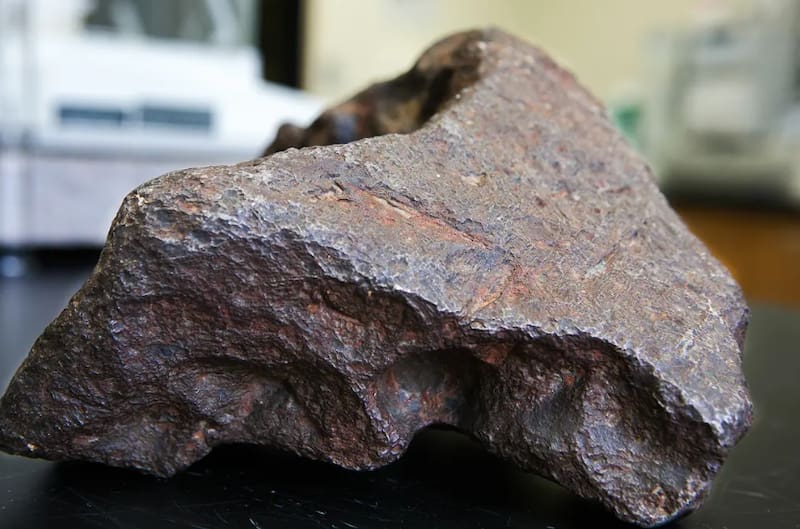
Researchers analyzed its composition and internal structure using different techniques. Among the materials identified were kamacite, taenite and schreibersite, characteristic minerals that made it possible to study the nature of the object.
Finally, the results made it possible to classify it as an iron meteorite belonging to the IIIAB group.
The meteorite was officially registered under the name Edmore, in reference to the Michigan town associated with its discovery.
The case was also presented by researchers from the Smithsonian Institution, the University of California, Los Angeles (UCLA) and Central Michigan University during the 50th Lunar and Planetary Science Conference, held in 2019.
The researchers noted that the story shows that meteorites may exist for years preserved on private properties or in private collections without their owners knowing their true scientific value.