
En esta noticia
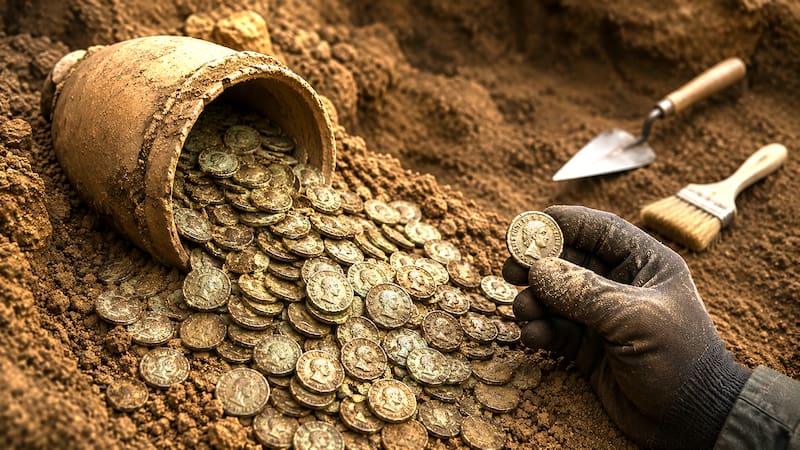
An enormous archaeological discovery was made in northeastern France by a team of professionals, who unearthed three vessels full of Roman coins that remained underground for approximately 1,800 years.
According to official information, this discovery-which took place in the present-day town of Senon-could contain more than 40,000 coins.
However, the value of this discovery is not only monetary, but the way they were buried also offers new information about daily life and saving practices that were carried out during the Roman Empire.
The coins unearthed by archaeologists in France
The excavations, led by the French National Institute for Preventive Archaeological Research (INRAP) found three amphorae buried under the floor of a house from what was a Roman settlement.
Two of them remained intact and still contained thousands of coins inside, while the third had been removed and only three coins remained in the pit where it was originally buried.
What the experts indicated
According to information collected by Live Science
- The first amphora weighed around 38 kilograms and would contain between 23,000 and 24,000 coins
- The second weighed about 50 kilograms and could hold between 18,000 and 19,000 coins
- The third had already been removed in Roman times
Why this discovery is key for archaeology
One of the key points of this find is the historical information provided by the way the coins were buried.
They were found in pits specially prepared to bury them and with the mouths of the containers at ground level, which allowed easy access.
Experts believe this arrangement reveals that it was not a hidden treasure but rather a long-term savings system, like a piggy bank.
The history of the settlement where these coins appeared
According to the details, at the beginning of the 4th century, a fire destroyed the settlement where these coins were found. Although it was later rebuilt, a second fire caused it to be permanently abandoned.
These coins were never recovered by their owners and remained buried for almost 2,000 years until they were discovered in this excavation.