
En esta noticia
What began as a preventive excavation for the expansion of a house ended up becoming one of the most important archaeological finds in recent years in France.
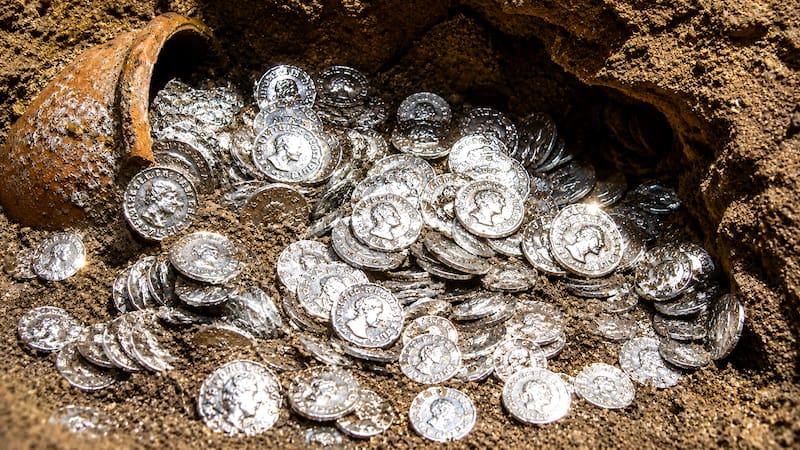
A team from the French National Institute for Preventive Archaeological Research (INRAP) discovered three ceramic vessels containing around 40,000 Roman coins buried some 1,800 years ago in the town of Senon.

How did they find the Roman treasure of more than 40,000 coins?
The discovery took place in Senon, a small town in the department of Meuse, in the French region of Lorraine. A preventive excavation was being carried out for the expansion of a house.
The work was led by INRAP and covered an area of about 1,500 square meters and made it possible to document the evolution of the settlement from the Gaulish period to the mid-4th century AD.
As the excavations progressed, the archaeologists found ancient limestone quarries, paved streets, ovens, courtyards, walls, and stone houses equipped with basements and even hypocaust heating systems, suggesting that the area had been inhabited by a relatively well-off community, possibly made up of merchants and craftsmen.
While carrying out the work, they found an ancient residential area where three large buried ceramic vessels were located. Two were full of coins and the third had only three.
According to INRAP estimates, the first had between 23,000 and 24,000 coins and the second between 18,000 and 19,000, so there are approximately more than 40,000 Roman coins in total.
Archaeologists discover an 1,800-year-old Roman treasure with more than 40,000 buried coins: Why do they believe it was not a hidden treasure?
Although the volume of coins was surprising, the researchers maintain that the vessels functioned as a kind of safe or household bank. According to INRAP, the containers were buried at a shallow depth, which would have allowed their original owners to add or withdraw coins easily.
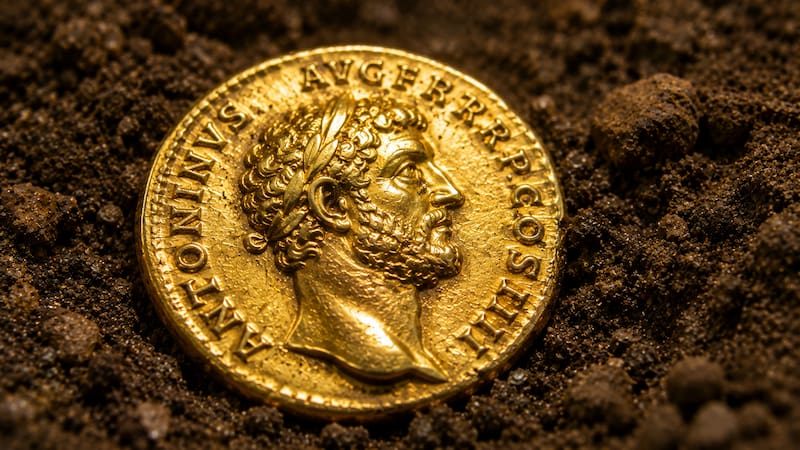
According to the specialists, they were buried approximately between the years 280 and 310 AD. Many of the coins bear the portraits of:
- Victorinus
- Tetricus I
- Tetricus II
The three rulers of the Gallic Empire, a state that temporarily broke away from the central power of Rome between the years 260 and 274 AD.


What else did the discovery of this 1,800-year-old Roman treasure reveal?
The biggest mystery is who gathered such a huge fortune only to abandon it and never return for it. Among the hypotheses, the one that carries the most weight is that it belonged to someone who managed finances.
The excavations also revealed that the settlement suffered a major fire at the beginning of the 4th century, after which it was rebuilt using part of the existing structures. Decades later, a second fire led to the final abandonment of the site around the middle of that century. Since then, the vessels remained buried under the rubble until they were discovered almost two millennia later.
As established by French law, the collection became the property of the State for cleaning, conservation and study, while the site was scanned in three dimensions before the land was returned to its owner.