
En esta noticia
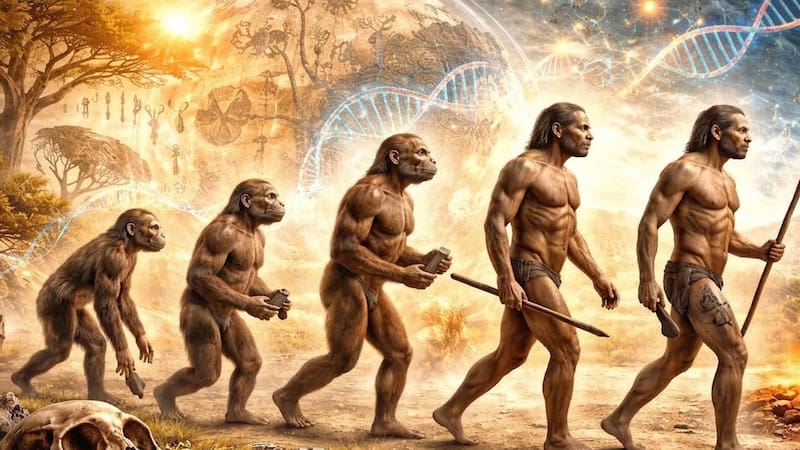
A group of scientists made a historic discovery about the origin of humanity after identifying genetic signals of an unknown human population that lived in Africa hundreds of thousands of years ago and left traces in the DNA of millions of people.
The discovery revealed that this ancient group did not disappear completely, but rather would have contributed genetic material that still remains present in modern humans.
The researchers believe that this inheritance may have played a role in brain evolution and some current human characteristics.

The lost human lineage that remained hidden in modern DNA
According to the study, the scientists used advanced genetic models to analyze the differences between different African populations and detect signals that did not fully match the human groups known so far.
The results pointed to the existence of an unknown ancestral population, which would have coexisted with other human groups and later would have passed on part of its genetic information through processes of mixing between populations.
The researchers estimate that this ancient population may have contributed a significant proportion of the DNA of some current communities, although questions remain about exactly when it lived, what its way of life was like, and what factors led to its disappearance as an independent group.
The possible link between ancient DNA and brain evolution
One of the aspects that most caught the scientists’ attention is the possibility that this lineage may have influenced certain processes related to human brain evolution.
Experts point out that genetic fragments inherited from ancient populations may have affected different biological functions, since DNA passed down through generations can influence human adaptation to different environments.
Although the study does not mean that this population was a completely new human species, it does represent an unknown piece of the complex puzzle of evolution.

Africa once again proves key to understanding the origin of humanity
For decades, Africa was considered the main setting where the first human groups emerged and evolved. New genetic analyses continue to reveal that the history of humanity was much more diverse and complex than previously thought.
Researchers maintain that there are still unknown chapters of human evolution waiting to be discovered through DNA, especially in populations that for a long time had not been studied in depth.
This discovery raises new questions about how different human groups interacted with one another and qwhat role those genetic mixtures played in the appearance of the characteristics that distinguish modern humans.