
En esta noticia
A shipment of 900 vehicles traveled from South Korea to Georgia, on the east coast of the United States, in just 72 hours without passing through the Panama Canal.
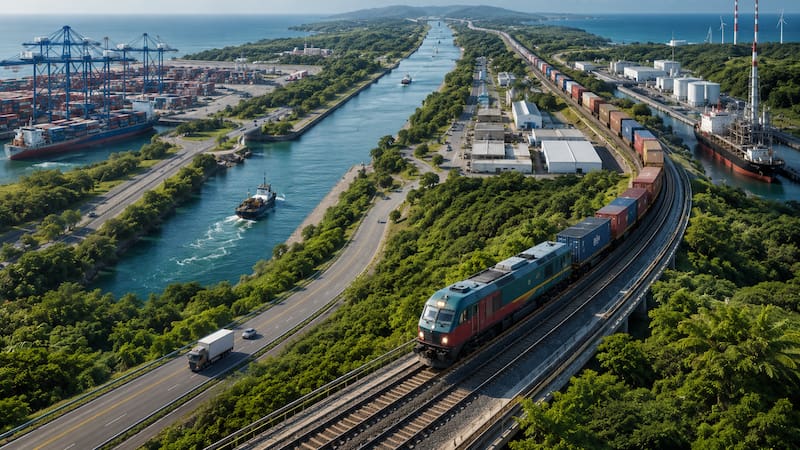
The operation, carried out by Hyundai and its logistics division Hyundai Glovis, crossed Mexico from ocean to ocean by train in nine hours through the Interoceanic Corridor of the Isthmus of Tehuantepec (CIIT). It is the first international commercial-scale test of this new route.
The operation was carried out between March 28 and April 3, 2025, and came at a strategic moment. The droughts that paralyzed the Panama Canal in 2023, when daily crossings fell from 38 to just 22 ships, could double before the end of the century if emissions are not reduced.
Lake Gatun, the freshwater source that feeds the locks, consumes more than 26 million gallons per transit and is the weak point of that route. The CIIT does not depend on the weather.
How the new route that avoids the Panama Canal works
The vehicles were unloaded in Salina Cruz, Oaxaca, on the Pacific. From there, 50 special railcars transported them along Line Z of the corridor to Coatzacoalcos, in the Gulf of Mexico, covering 308 kilometers in nine hours. A second ship completed the journey to Brunswick, Georgia.
The CIIT is a multimodal logistics platform managed by Mexico’s Navy Secretariat that integrates four ports. Line Z went into service in December 2023, and two additional lines are under expansion.
Current state of the corridor
- Line FA (Coatzacoalcos-Palenque): in service since September 2024
- Line K (447 km to Guatemala): first section inaugurated in November 2025
- Industrial parks: 14 planned, several already concessioned

The changes it implies for trade between Asia and the United States
Nino Morales, president of the Special Commission for Monitoring the CIIT, described Hyundai’s test as a demonstration that consolidates the route as a strategic alternative for global trade. Authorities estimate that the corridor could move up to 5,000 vehicles per week once full capacity is reached.
The corridor does not compete with Panama in massive container volume, but in speed and reliability for high-value cargo. Full operating capacity is projected for mid-2026, and the nearshoring context, the relocation of manufacturing to Mexico, and geopolitical uncertainty reinforce the appeal of an alternative that does not depend on a single lake.