
En esta noticia
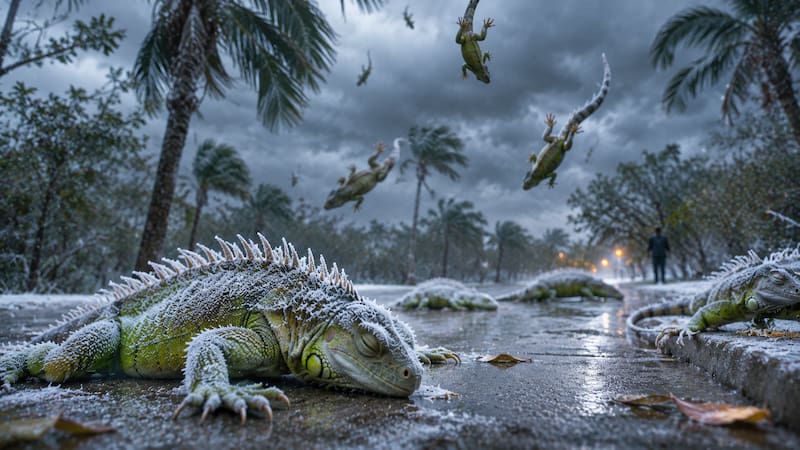
The arrival of a cold snap in Florida this Saturday has revived a familiar warning: the possibility of a “rain of iguanas,” especially in the southern part of the state, where these invasive reptiles can be stunned by low temperatures and fall from trees even if they are not dead.

South Florida is home to many of the green iguana colonies, an invasive cold-blooded species that does not tolerate low temperatures well and can temporarily lose mobility when the temperature drops, according to the Florida Fish and Wildlife Conservation Commission (FWC).
Why does a rain of iguanas happen in Florida, and what precautions should be taken?
That is the case this weekend, when lows of 50 to 59°F (10 to 15°C) are expected across much of South Florida, the lowest since late March, according to the National Weather Service (NWS).
In Miami, the forecast high for Saturday is 23 degrees Celsius (73 Fahrenheit), compared with the usual 28 degrees (82 Fahrenheit) for this time of year.
When temperatures approach freezing, iguanas can enter a state of lethargy in which they temporarily lose muscle control.
In those conditions, they can fall out of trees and onto the ground, although they regain mobility once they warm back up, the FWC says.
Despite the new cold front, the FWC will not repeat the operation it carried out in February to collect ‘frozen’ iguanas.
Back then, during another cold snap, it allowed residents to pick up stunned iguanas from their property without a permit and set up five temporary drop-off centers at its offices, where it received more than 5,000 in two days.
In its recommendations, the FWC urges people not to take iguanas home or into a vehicle to warm them up, because once they recover they quickly become defensive and can bite, scratch and whip their tails.
It also notes that it is illegal to keep them alive without a permit, release them or move them elsewhere.
Why is the green iguana considered an invasive species in Florida?
The green iguana (Iguana iguana), native to Central America and tropical South America, arrived in Florida as a pet in the 1960s. In 1964, an exotic-animal dealer released more than 300 of them in the Miami area, according to University of Florida records.
This lizard, usually green but sometimes brown or olive, has a long tail and a row of spines along its back. Males can grow to more than 5 feet (1.5 meters), including the tail, and turn orange during mating season.
The FWC considers it an invasive species because it damages gardens, digs burrows that can undermine sidewalks, foundations, and retaining walls, and eats a plant that is essential to the survival of the endangered Miami blue butterfly.
The NWS issued a freeze warning for early Saturday in northwest Florida, where lows could fall to 1 degree Celsius (34 Fahrenheit). In Tallahassee, the state capital, the high will not top 16 degrees (61 Fahrenheit), compared with the usual 23 (73).
In Orlando, in the central part of the state, lows of 8 degrees Celsius (47 Fahrenheit) and highs of 18 (65) are expected, below the usual 15 (59) and 26 (79), respectively.
Source: EFE.