
En esta noticia
Washing fruit and vegetables before eating them can help reduce the amount of microorganisms present on their surface, but not all methods have the same effect.
A study published in Journal of Food Protection tested different household washing methods and specifically compared solutions of water, 5% vinegar and 13% lemon.
The study used lettuce, broccoli, apples and tomatoes experimentally contaminated with Listeria innocua, a microorganism used as a substitute for Listeria monocytogenes in previous research.

The researchers Agnes Kilonzo-Nthenge, Fur-Chi Chen and Sandria L. Godwin analyzed what happened after soaking the foods for two minutes in different solutions and then rinsing them under running water.
Is it better to wash fruit and vegetables with 5% vinegar, water or 13% lemon?
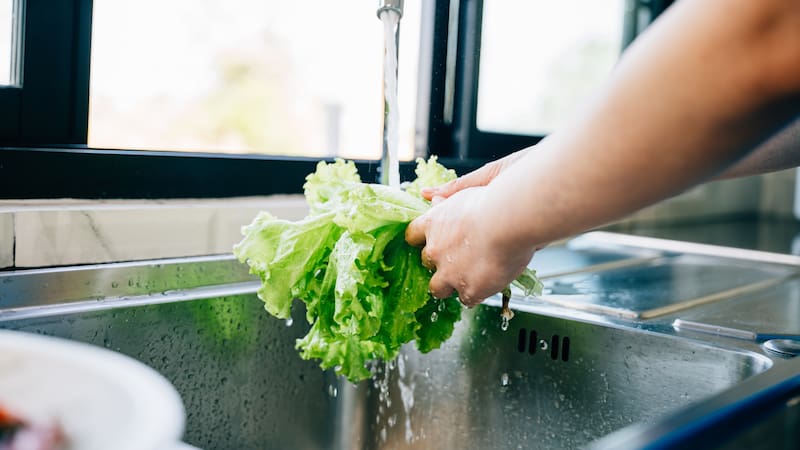
According to the study results, cold running water is an effective and practical alternative for reducing surface contamination. In particular, the researchers found that soaking the produce for two minutes and then rinsing it could produce a greater bacterial reduction than simply rinsing it.
The research tested a 5% vinegar solution and a 13% lemon solution, but did not find a statistically significant advantage of these alternatives over cold water in the case of lettuce.
The authors’ conclusion was clear: they found no sufficient reasons to consider vinegar or lemon superior to cold tap water for this procedure.
“Reductions in surface contamination of lettuce after soaking it in lemon or vinegar solutions were not significantly different (P > 0.05) from those obtained by soaking it in cold tap water”, the study states.

5% vinegar and 13% lemon for washing fruit and vegetables: how effective are they?
The 5% vinegar and 13% lemon were the other two treatments evaluated by the researchers. Both were applied to lettuce.
Some specimens were submerged for two minutes in a vinegar solution, while others were placed in a lemon solution. Then, all were rinsed for 15 seconds with running water.
Regarding vinegar, the average reduction of Listeria innocua was 1.88 log CFU/g. For comparison, soaking for two minutes in water followed by a rinse produced a reduction of 1.79 log CFU/g, while lemon reached 1.72 log CFU/g.
Although the figures are different, the analysis determined that the differences between the treatments were not significant.
How does the study recommend washing fruits and vegetables?
The method the researchers consider appropriate is washing produce under cold running water and rubbing or brushing it whenever the surface allows it.
In the experiment, simple rinsing for 15 seconds performed worse on lettuce than the procedures that included a pre-soak. In apples and tomatoes, it was also observed that soaking followed by a rinse could improve bacterial reduction.
“Instructing consumers to rub or brush fresh produce under cold running tap water before consuming it”, experts consider appropriate.
The study also found that irregular surfaces can be more difficult to clean. In apples, for example, the stem and blossom-end areas retained greater contamination after washing than other parts of the surface.
How long should fruits and vegetables be left to soak?
The study compared a two-minute soak against one of 30 and concluded that the longer procedure did not produce a significant difference compared with the shorter one. In turn, the authors considered that keeping produce in water for half an hour was not practical for consumers.
In apples, for example, a two-minute soak in water followed by a rinse produced an average reduction of 2.32 log CFU/g.
In tomatoes, the commercial product used in the study had the greatest reduction, with 2.89 log CFU/g. Soaking in water followed by a rinse reached 2.53 log CFU/g.
In broccoli, by contrast, the differences between the different treatments were much smaller and were not statistically significant.