En esta noticia
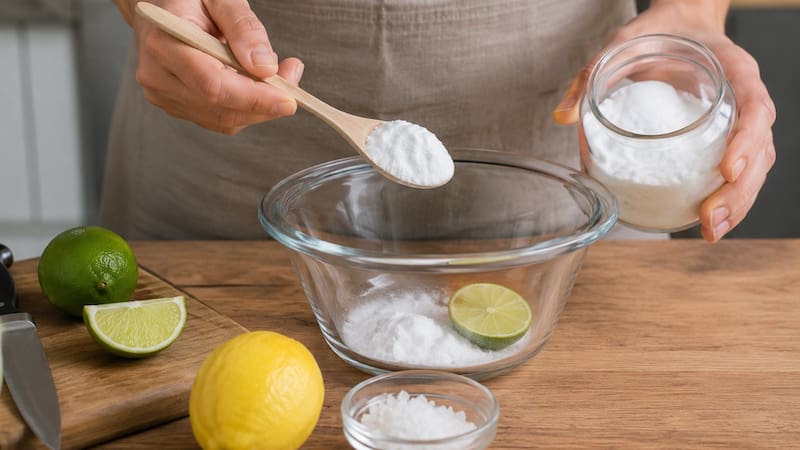
Mixing baking soda with lemon and salt has become one of those home tricks that frequently circulate to solve different household tasks. The combination takes advantage of the properties of each ingredient and can be used mainly as support for removing dirt, stains, and some residue from surfaces.
However, the fact that a mixture is popular does not mean it works for everything or that it can be used on any material. Before applying it, it is important to know what each ingredient can contribute and when it is best to avoid it.

What is mixing baking soda with lemon and salt for?
The mixture of baking soda, lemon, and salt is mainly recommended as a homemade alternative for cleaning tasks. Baking soda works as a slightly abrasive agent, while salt can help loosen stuck-on dirt when rubbed carefully.
Lemon, for its part, adds acidity and can help work on certain residues and stains. It also leaves a citrus smell that many people associate with a sense of cleanliness.
For that reason, this preparation can be useful for cleaning some resistant surfaces, especially when looking for a simple option with ingredients that are usually available at home.

What happens when baking soda is mixed with lemon and salt?
When baking soda and lemon are combined, a visible chemical reaction occurs, with foam forming and carbon dioxide being released. That effervescence can help move some dirt on the surface, although it does not mean the mixture is a universal cleaning product.
Salt does not turn the preparation into a disinfectant. Its main contribution in this type of home remedy is related to friction, especially when used on materials that can tolerate this kind of cleaning.
In other words, the appeal of this mixture lies in combining gentle abrasive action, acidity, and friction, but each surface requires a different treatment.
How do you use baking soda with lemon and salt to clean?
A simple way to prepare the mixture is to place a small amount of baking soda and salt and add a few drops of lemon juice until a paste is obtained. This preparation can be spread over a resistant surface and left to act for a short period before gently scrubbing and removing the remains.
There is no need to use large amounts. In fact, using too much mixture can make rinsing difficult and leave residue.
The most advisable thing is to test it first on a hidden area. If the surface changes color, loses shine, or shows any damage, use should be stopped immediately.
On which surfaces should this mixture not be used?
Although baking soda, lemon, and salt are common ingredients, that does not mean they are safe for all surfaces. The acidity of lemon and the abrasive effect of the mixture can affect some materials.
It is better to avoid it on delicate surfaces or surfaces sensitive to acids, such as marble, unprotected granite, natural stone, some metal surfaces, and certain glossy finishes.
It is also wise to be cautious with objects that can be easily scratched. In these cases, it is better to use products specifically formulated for that material and follow the manufacturer’s instructions.