
En esta noticia
In the field of civil engineering, the fight against seismic movements does not stop. Recently, an innovation developed at Sharjah University (United Arab Emirates) captured global attention after obtaining its patent in the United States in December 2025. It is a mechanical device that promises to change the rules of the game in the protection of critical structures.
The system, led by Professor Moussa Leblouba, does not depend on complex sensors or external power sources. Its effectiveness lies in pure physics: a controlled friction mechanism designed to “eat up” the vibration before it damages a building’s columns or beams.
How does the “sphere damper” work?
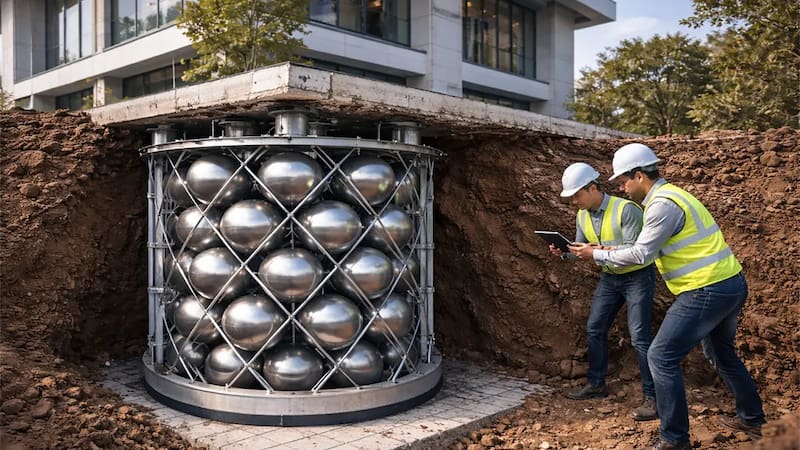
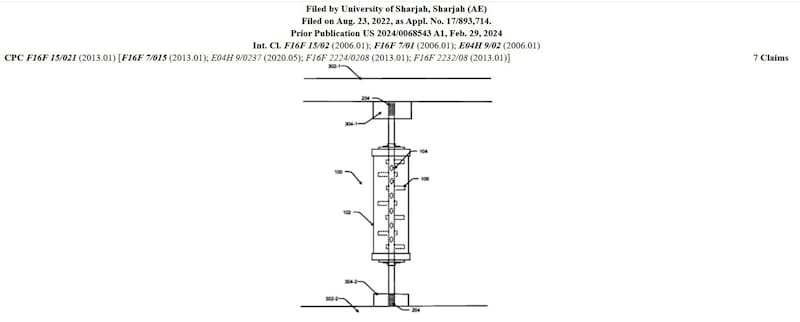
Unlike traditional hydraulic dampers (similar to those in a car, but on a giant scale), this device has a unique internal architecture. It is a hollow cylinder filled with solid steel spheres.
- The mechanism: in the center, it has a shaft with radial rods that look like the branches of a tree.
- The action: when the ground shakes, the rods move between the steel spheres.
- The result is that movement generates intense friction that dissipates approximately 14% of seismic energy in laboratory tests, transforming kinetic motion into residual heat.
Why is “passive” technology vital in a catastrophe?
One of the biggest problems during a major earthquake in modern cities is the immediate cutoff of the power supply. This is where Leblouba’s invention has the edge.
Being a 100% passive system, it does not need electricity to operate. While other smart systems could fail if batteries or generators are damaged, this mechanical friction device remains operational 24 hours a day, ensuring protection even in the worst service-collapse scenarios.
A solution for the “Wild West”
For Argentina, this news is especially relevant. With provinces such as Mendoza, San Juan, and Salta located in areas of high seismic risk, the great challenge is not only building new structures, but protecting the thousands that are already standing.
Many of today’s seismic protection systems, such as base isolators (which separate the building from the ground), require monumental works and prohibitive costs. In contrast, this new device stands out for two key factors:
- Modular design: if one part is damaged after an earthquake, there is no need to throw away the entire device. The affected component is disassembled and replaced, reducing maintenance costs.
- Retrofitting (Reinforcement): The system can be adapted to existing structures without the need for major structural renovations. This opens a door for schools, hospitals, and old public buildings in the country that today do not meet the most modern earthquake-resistant standards.
Is 14% dissipation enough?
Although 14% may seem like a modest number compared with high-end dissipaters that promise higher figures, experts point out that the advantage here is the cost-benefit ratio.
Conventional hydraulic dampers often suffer fluid leaks over time and lose usefulness after a single severe event due to permanent deformation. The Sharjah device, by contrast, has the ability to automatically return to its original position after the vibrations stop, ready for a possible aftershock without immediate human intervention.