
En esta noticia
The Immigration and Customs Enforcement (ICE) modified the rules its agents must follow during detentions, after a series of operations that ended in chases, injuries, and deaths.
The new directive limits vehicle chases and establishes that some maneuvers may only be carried out by officers who have specific training, with the aim of reducing risks during immigration procedures.
ICE’s role: What is its mission, and what is it not authorized to do?
The agency, part of the Department of Homeland Security (DHS), is responsible for investigating federal crimes and enforcing immigration laws within the United States.
Within this agency, there is a special division of Enforcement and Removal Operations (ERO), which handles identifying, arresting, detaining, and removing people subject to federal immigration laws.
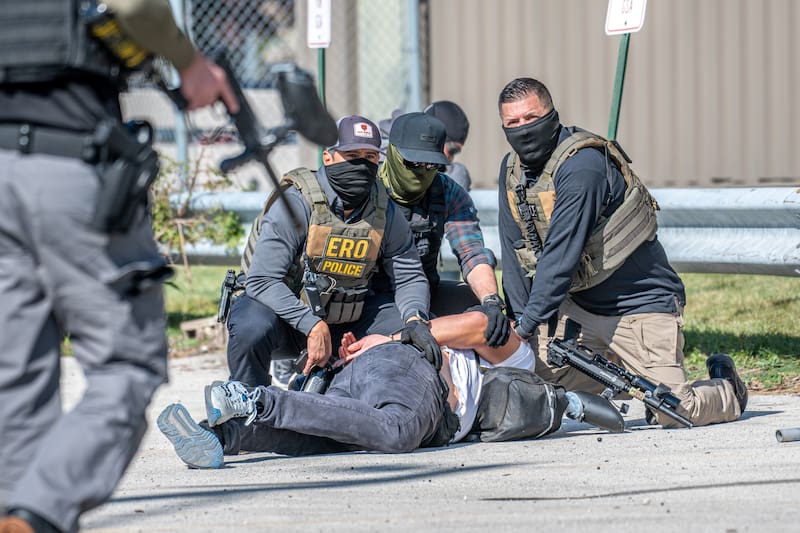
However, these powers have limits. Agents must act within the authority granted to them by the laws and the agency’s policies.
What is the new order for ICE?
ICE issued a new internal guide for ERO agents that prohibits vehicle chases and sets higher requirements for carrying out car stops.
The new directive states that ERO officers are not authorized to initiate high-speed vehicle chases.
This means that if a person flees, they must record data such as the license plate and the vehicle’s features in order to continue the investigation later.
To carry out certain vehicle stops, agents must meet conditions such as:
- Having received prior training.
- Having an operational camera.
- Using official vehicles equipped with visible lights and sirens.
In addition, some maneuvers are reserved exclusively for specially trained personnel. These include techniques to block a vehicle and prevent it from escaping, and the use of spike devices intended to deflate its tires.
Why was this new order given to ICE?
The decision comes after a series of incidents that occurred during ICE vehicle operations that even ended with drivers being injured. According to official reports, at least four people died, and others were injured.
One of the most recent cases is that of Wilber Rafael Garces Perez, which occurred on September 20 in Austin, Texas. According to federal prosecutors, the man hit an agent with the side mirror of his vehicle while trying to escape. He was then chased and shot.
The new guide seeks to prevent arrest attempts from turning into high-speed chases and to reduce the possibility of dangerous confrontations during vehicle checks.
What relationship does the new order have with ICE’s mass hiring?
This measure also appears in the context of questions about the rapid growth in the number of ICE agents. In January 2026, the agency reported that it had hired 12,000 new officers in less than a year, after receiving US$75 billion in funding approved by Congress to expand its immigration operations.
A complaint filed by a former agency official claims that, during this hiring campaign, some new employees began to be hired without having first completed basic background checks.
According to The Associated Press, Human Resources even made final job offers before preliminary checks such as fingerprinting, identity verification, and credit checks were completed.
The complainant argued that this situation represented an unprecedented reduction in hiring standards and could increase internal risks for the agency.