
En esta noticia
Alphabet, Google’s parent company, saw its stock fall 12.6% on Thursday, wiping out nearly $500 billion in value in its worst day since going public in 2004. The drop could show up in the 401(k) accounts of millions of Americans whose retirement savings include the stock.
The plunge followed Alphabet’s July-to-September results, released Wednesday after the market closed. Google’s search business brought in $63.35 billion, less than Wall Street analysts expected, and the company spent $9.07 billion more cash than it took in as it poured money into AI.
Google’s chief business officer, Philipp Schindler, said search took a hit partly because AI Mode, a feature that answers questions in conversation-style text instead of a list of links, earns less from ads. He said Google is now expanding ads in its AI features.
The fall topped Alphabet’s previous worst day, an 11.6% drop in March 2020. In dollar terms, only Nvidia has lost more value in a single day, about $593 billion in January 2025.


How did Alphabet’s stock drop affect your 401(k)?
Money in a 401(k) is usually invested in funds, which pool savings from many people to buy stocks, bonds or both. Many popular funds follow the S&P 500, a list of 500 of the largest U.S. companies, where Alphabet makes up between 5% and 6% of the total.
That share is big enough to matter. For every $10,000 invested in an S&P 500 index fund, Alphabet’s drop alone erased roughly $65 to $75 on Thursday.
However, the overall hit was smaller. The S&P 500 slipped just 0.3% that day, about $30 on a $10,000 balance, because gains in other stocks offset part of the loss. The Nasdaq, an index heavy with tech companies, fell 1.4%.
How much your own balance moved depends on how your money is invested. Many 401(k) savers use a target-date fund, which mixes stocks with safer investments like bonds and gets more cautious as retirement nears. The more bonds in your fund, the smaller the hit from a stock drop.
How are 401(k) plans affected by stock market swings?
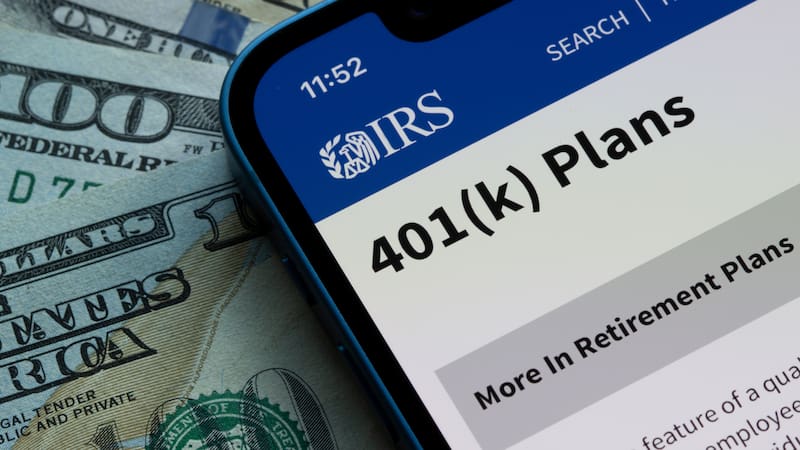
A 401(k) is a retirement savings account offered through your job. Part of each paycheck goes into the account before taxes are taken out, and many employers add extra money, known as a match.
That money doesn’t sit in cash. Each plan offers a menu of investment choices, from safer to riskier. Because most of them include stocks, your balance goes up when the stock market rises and down when it falls.
For the 2026 tax year, the IRS raised the 401(k) contribution limit to $24,500, up from $23,500 in 2025. Workers 50 and older can save more through catch-up contributions:
- Ages 50 and older: an extra $8,000, for a total of $32,500 a year.
- Ages 60 to 63: a higher catch-up of $11,250 under the SECURE 2.0 Act, for a total of $35,750.
Americans held $10.8 trillion in 401(k) plans as of June 30, according to the Investment Company Institute, a trade group for fund companies. Nearly 70 million workers were actively contributing to these plans at the end of 2025.

What should 401(k) savers do after a big market drop?
A drop matters most if you need the money soon. If retirement is years away, prices have time to recover, as they did after past crashes such as the dot-com bust of 2000, the period after 9/11 and the 2008 financial crisis.
A drop is only a loss on paper until you sell. Selling after prices fall turns that paper loss into a real one, and you miss out if prices bounce back.
Taking money out early also costs extra. Withdrawals before age 59½ are generally taxed as income and may carry an additional 10% tax, unless you qualify for an exception or your plan allows a loan.
Retirees face a different situation. Starting at age 73, the IRS requires people to take out a minimum amount each year, so some may have to sell investments while prices are down.
Before making changes, check how your account is invested and when you’ll need the money. A financial adviser can help you match your investments to your timeline.