
En esta noticia
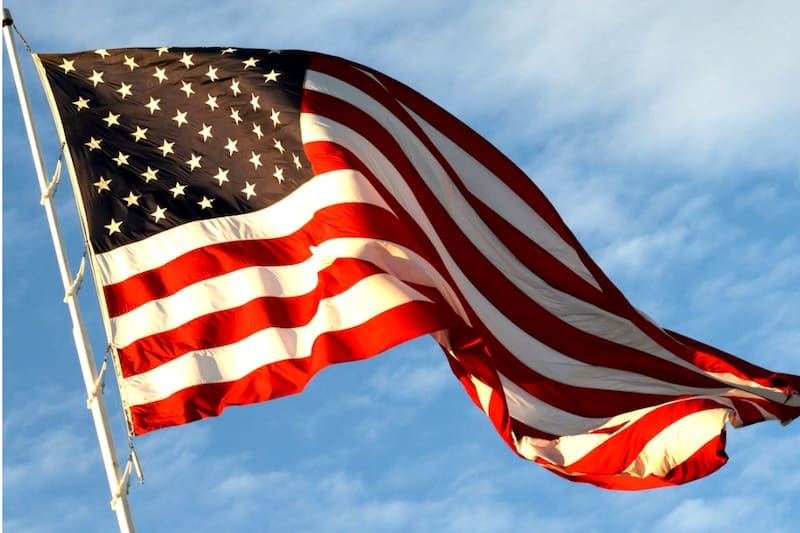
The American flag is protected by federal law, but there are also specific rules governing how it should be displayed and treated. The guidelines are included in the U.S. Flag Code, which establishes standards for the flag’s use by civilians.
However, not every violation of the Flag Code is a crime. Most of its provisions do not include an enforcement mechanism and are considered advisory guidelines.
Things you should never do with the American flag
Under Section 8 of Title 4 of the United States Code, the flag should be treated according to a series of rules. Among the practices listed in the code, the flag should not:
- Touch the ground, floor, water, or merchandise.
- Be displayed with the blue union facing downward, except as a signal of extreme danger to life or property.
- Be carried flat or horizontally instead of being kept aloft and free.
- Be used as clothing, bedding, or drapery.
- Be fastened, displayed, or stored in a way that allows it to become easily torn, soiled, or damaged.
- Be used as a ceiling covering.
- Have words, letters, pictures, designs, or other marks placed on it.
- Be used as a receptacle for carrying, holding, or delivering objects.
- Be used for advertising purposes.
The Flag Code also establishes rules for displaying the flag from buildings, balconies, vehicles, and alongside other flags. For example, when the flag is displayed from a staff projecting from a window, balcony, or the front of a building, the blue union should be positioned at the peak of the staff unless the flag is at half-staff.
Can you be fined for breaking the Flag Code?
In most cases, breaking one of these display rules does not automatically mean a person will receive a federal fine or go to jail.
The Congressional Research Service says that most provisions of the Flag Code have no explicit enforcement mechanisms. Courts have also treated many of the rules as declaratory and advisory rather than independently punishable requirements.
There is, however, a specific federal statute covering certain uses of the flag for advertising and merchandise in the District of Columbia. Under 4 U.S.C. §3, certain conduct involving placing words, designs, or advertisements on the flag, or using a representation of the flag on merchandise for advertising purposes, is classified as a misdemeanor and can carry a fine of up to $100, up to 30 days in prison, or both.
That provision should not be interpreted as meaning that every violation of the Flag Code results in a $100 fine. The federal law is narrower than the general guidelines contained in Section 8.
What about burning or damaging the American flag?
Flag burning is one of the most important exceptions to understand because the First Amendment protects certain expressive uses of the flag.
In Texas v. Johnson, the Supreme Court ruled in 1989 that the government’s prosecution of a person for burning the American flag as political expression violated the First Amendment. The Court later reached a similar conclusion regarding the federal Flag Protection Act in United States v. Eichman.
As a result, a person generally cannot be prosecuted simply because they burned an American flag as a form of political expression. The Supreme Court’s decisions mean that the government’s ability to punish flag desecration is limited when the conduct is protected expressive activity.
The key distinction is that the Flag Code establishes how the flag should be treated, while the Constitution determines when the government can legally punish someone’s conduct or expression. For most Americans, following the Flag Code is therefore a matter of respecting the country’s official guidelines rather than avoiding an automatic federal penalty.