

En esta noticia
Between Denmark and Germany, one of Europe’s most impressive engineering projects is moving forward: the Fehmarnbelt, an 11-mile tunnel that will run beneath the Baltic Sea and connect the two countries in just minutes. It will be the world’s longest immersed tunnel, built by sinking huge concrete sections into the seabed, and also the longest tunnel that combines road and rail in a single structure.

The world’s longest immersed tunnel is under construction: It will link two countries in minutes
The tunnel will connect the towns of Rødbyhavn, in Denmark, and Puttgarden, in Germany, two points now linked by ferry across the Fehmarn Strait. The project will replace that sea service and drastically cut travel times: a trip that now takes about 45 minutes by ferry will take about 10 minutes by car and around 7 minutes by train. On a larger scale, the train ride between Hamburg and Copenhagen will be cut by about two hours, a major boost for the link between Central Europe and Scandinavia.
Instead of boring through rock, the tunnel is being assembled from 89 huge prefabricated concrete sections. Each one is 217 meters long and weighs about 73,000 tons. They are being manufactured at a special plant in Rødbyhavn, floated into position, and lowered with millimeter precision into a trench that was previously dug in the seafloor, where they are joined one by one until the route is complete. The result is a tunnel that runs along the seabed, unlike tunnels bored deep into rock.
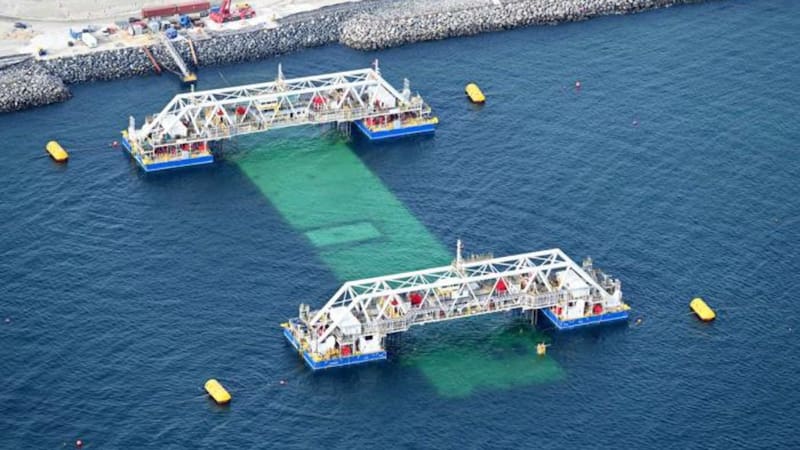
The Fehmarnbelt is not just a one-purpose tunnel. It will have a four-lane highway (two tubes for vehicle traffic) and a bidirectional, electrified rail line (two more tubes), where trains will be able to travel at up to 200 kilometers per hour, as well as a service gallery for maintenance and emergencies. In other words, cars, trucks, and trains cross the Baltic underwater, all within the same structure.
How much does it cost, and when does it open?
This is a project of historic scale, with an estimated cost of around 10,000 million euros. Construction is being carried out by Femern A/S (part of the Danish state-owned Sund & Bælt group) together with the consortium of contractors doing the work. Opening, for both vehicle and train traffic, is scheduled for 2029.