
En esta noticia
White vinegar is a cleaning ally because of its properties that help remove everyday dirt, grease residue, and stains caused by minerals that build up on different surfaces.
However, its smell is not so pleasant and many therefore give up on using it as a supplement. That is why mixture tricks were discovered, like the one made with orange peels, so they leave a more enjoyable fragrance thanks to their essential oils.
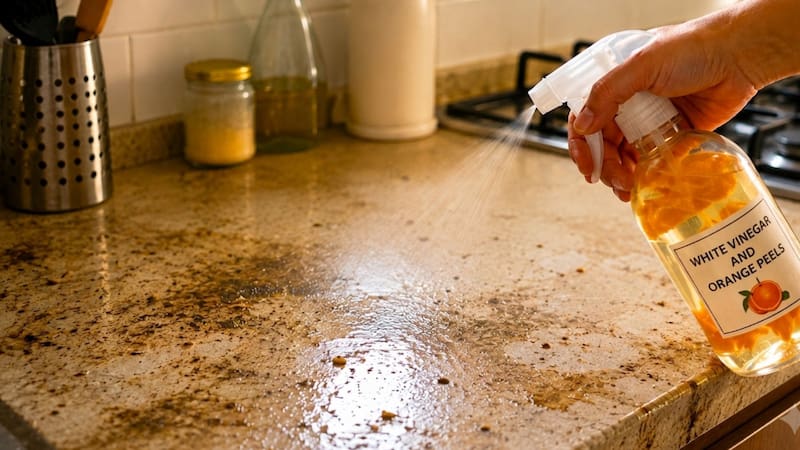
What spraying white vinegar and orange peels on the kitchen countertop is for
On countertops made of materials such as laminate, stainless steel, or sealed granite, it can help to:
- Remove grease residue and dirt
- Eliminate splash marks and food residue
- Neutralize odors left after cooking
- Leave a fresh citrus scent in the kitchen
- Clean other washable surfaces such as tiles, the outside of the refrigerator, or cabinet doors

How to prepare the white vinegar and orange peel mixture for the kitchen countertop
To prepare this mixture, place the peels from one or two oranges and cover them completely with white vinegar. Then it should be covered and left to rest in a cool, dark place.
After letting it macerate for between 7 and 14 days, the preparation should be strained and placed in a spray bottle with one part water.
Spray it on the countertop and wipe with a clean microfiber cloth until the dirt is removed. If the surface has been in contact with raw food, it is also advisable to rinse with clean water and dry with another cloth.
Why spraying white vinegar and orange peels on the kitchen countertop is recommended
This preparation became popular because it combines the cleaning power of white vinegar with the natural aroma of orange peels. While the vinegar helps remove everyday dirt and stains, the peels provide essential oils that soften its characteristic smell and leave a more pleasant citrus fragrance.
However, it is not a suitable mixture for all surfaces. It is recommended to avoid using it on:
- Marble
- Natural stone
- Unsealed granite
This happens because the acetic acid in vinegar can damage these materials with frequent use. In addition, although it is useful for daily cleaning, it does not replace a disinfectant when it is necessary to eliminate microorganisms in situations that require specific disinfection.