En esta noticia
In many kitchens, stuck-on grease residue can become one of the hardest problems to solve, especially when it remains for several hours on dishes, cutlery, baking dishes, or containers.
Although detergent is the usual option, there are homemade alternatives that can complement cleaning.
One of them is to use lemon, a common ingredient that contains citric acid and can help loosen certain grease and dirt residue.

Lemon on dishes: the trick that helps remove stuck-on grease
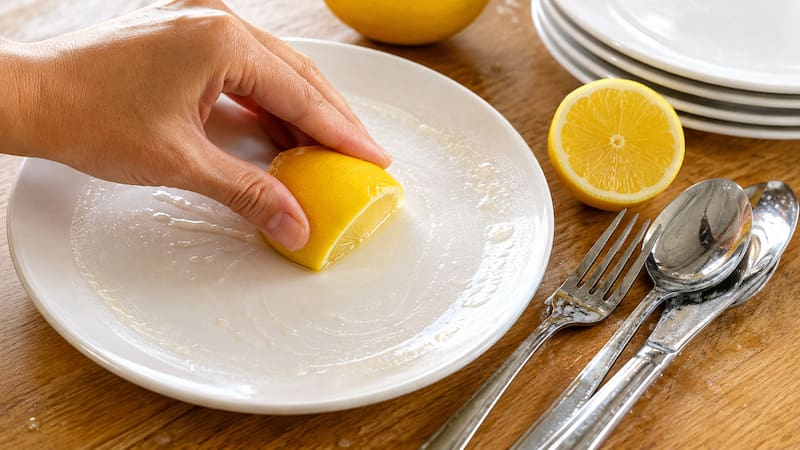
Lemon can be used directly on a surface that has adhered grease residue. To do so, you can cut one in half and gently rub the pulp over the area you want to clean.
The action of the citric acid can help loosen greasy residue, especially when combined with warm water and detergent. In this sense, lemon works as a cleaning aid and not necessarily as a replacement for dishwashing liquid.
For better results, it is advisable to remove solid food residue first and then rub the lemon over the surface. Afterward, the utensil can be washed normally with water and detergent.
Why does lemon help remove grease from cutlery?
The main reason is related to its composition. Lemon juice contains citric acid, a compound that can help loosen certain residue and deposits that stick to surfaces.
When the pulp is rubbed directly on a plate or piece of cutlery, a combination of mechanical and chemical action occurs: on one hand, the motion helps remove dirt; on the other, the acids in lemon can make it easier to remove certain residue.
However, it is important to distinguish between surface grease and very stuck-on dirt. When an utensil has a significant layer of grease, detergent remains essential to complete cleaning.
How to use lemon to remove stuck-on grease from dishes
The process is simple and can be done before the usual washing.
- Remove food residue from the plate or cutlery.
- Cut a fresh lemon in half.
- Gently rub the inner part over the greasy area.
- Let it sit for a few minutes if the residue is very stuck on.
- Rinse with water.
- Finally wash with dish detergent and water.
In the case of a pan, baking dish, or container with a heavy buildup of grease, it may be more effective to combine hot water, detergent, and a small amount of lemon juice.
The lemon trick can also help with bad odors
Beyond being used to treat certain residue, lemon is known for its citrus aroma, so it can be useful to temporarily improve the smell that remains on some utensils after cooking.
This can be especially practical after preparing foods with strong odors. However, the pleasant aroma does not mean the surface has been disinfected, so it is always necessary to complete the corresponding washing.
What precautions should be taken when cleaning with lemon
Although lemon is a common ingredient in the kitchen, it should not be used indiscriminately on any surface.
Its acidity can affect some delicate materials or finishes, so it is advisable to test first on a small area when there are doubts about compatibility.
It is also important not to mix lemon with cleaning products that could generate dangerous chemical reactions. In particular, it should never be combined with bleach, since acids can promote the release of irritating gases.
For this reason, when cleaning dishes and cutlery, the safest approach is to use lemon as a complement and then perform a conventional wash with detergent and plenty of water.