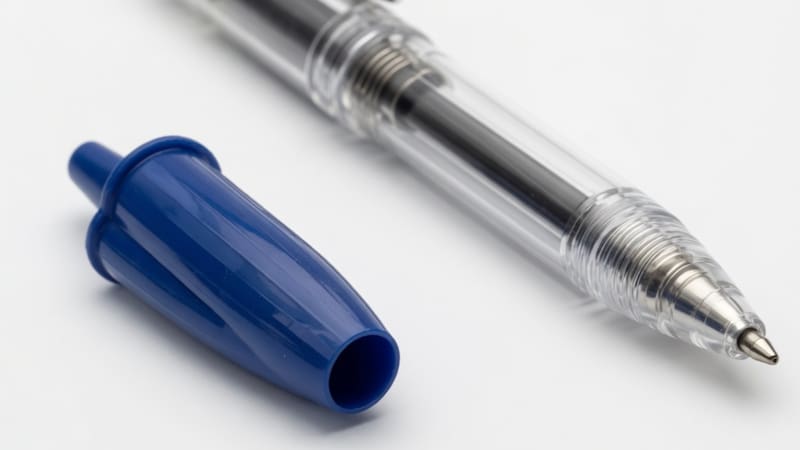

If you’re wondering what the little hole in pen caps is for, the story began with a tragedy.
For decades, thousands of children around the world died or suffered serious injuries after accidentally swallowing a pen cap.
In response, the International Organization for Standardization (ISO) established ISO standard 11540, which requires pen caps to have a ventilation hole.
The hole serves a critical purpose: if the cap is swallowed and becomes lodged in the windpipe, the opening allows a small amount of air to pass through, buying time to get emergency medical care before complete suffocation sets in.

How the hole in pen caps works
The mechanism is simple. In adults, the human windpipe measures about 1.5 to 2 centimeters in internal diameter. A standard pen cap can block that space almost completely.
However, a hole just 5.08 mm in diameter - the minimum required by ISO - allows an airflow of 8 to 10 liters per minute, enough to prevent death from hypoxia.
This minimal oxygen flow is not enough to breathe normally, but it can buy the crucial minutes needed to get the patient to an emergency room.

In addition to its safety function, the hole has a secondary practical benefit: it equalizes the pen’s internal and external pressure. That prevents ink from leaking out when pressure changes.
What to do if a child swallows a pen cap
Even though the hole in the cap reduces the risk, choking remains a medical emergency. If a child swallows a pen cap, the first step is to stay calm and check whether the child can breathe. If the child is coughing, crying, or making sounds, that means air is still moving.
In that case, call emergency services immediately and take the child to the nearest hospital without trying to remove the object by hand, since the wrong maneuver can make the blockage worse.
If the child cannot make a sound or breathe, perform the Heimlich maneuver immediately while someone else calls emergency services.
The best measure in any case is prevention: do not leave pens near children under 3, and choose products that comply with ISO 11540.