
En esta noticia
Byung-Chul Han, the 67-year-old South Korean philosopher, published his new book Without Respect: A Social Crisis in September 2026, in which he examines a society that is increasingly turned inward and has less ability to listen to others. It is a concern he had already voiced in 2023, when he described people walking down the street with their ears blocked.
In an interview with El País, the essayist also reflected on freedom, the pressure to perform, writing, and his own contrarian way of living. His words take on new meaning in light of his latest essay, where he focuses on respect and how its loss affects relationships between people.

Without Respect, Byung-Chul Han’s new book on the social crisis
Without Respect is an essay published by Paidós on September 23, 2026. Across its 128 pages, Han takes aim at dehumanization and calls for a new culture of respect, a virtue he says is in danger of disappearing in a society defined by narcissism, competition and digital disinhibition.

The philosopher points to neoliberal meritocracy, which creates losers who come to despise themselves and others as well. He adds that on social media, attention takes the place of respect and public humiliation replaces courtesy.
But the book does more than condemn: it proposes a politics of friendship, a way of living together based on distance, attention and mutual recognition, which Han sees as essential to democracy and to a full life.
People walk around with their ears blocked and cut off from the world
Han’s concern about the inability to listen did not begin with Without Respect. In 2023, in an interview with El País, the philosopher was already talking about a society that had lost the patience to listen and to tell stories. “People now walk around with their ears blocked,” he said.
He explained it with a scene from his own life: “Since I don’t orient myself well spatially, when I go somewhere, I ask people where a certain street is, but their ears are blocked by headphones.”

For Han, that everyday image captures a bigger problem. “They can’t hear, and that means they’re disconnected from the world, from others; they only hear themselves talk, wrapped up in their ego,” he said.
Individual freedom as capital’s cunning
In the same conversation, the essayist questioned whether freedom can be understood through the individual. “As Marx said, individual freedom is capital’s cunning. We think we’re free, but deep down we’re producing, increasing capital,” he said.
He carried the argument to its conclusion: “That means that with our individual freedom, we are only the sexual organs of capital.” He also returned to one of his central ideas: “Under the compulsion to perform and produce, there can be no freedom. I force myself to produce more, to perform more, I optimize myself to death; that is not freedom.”
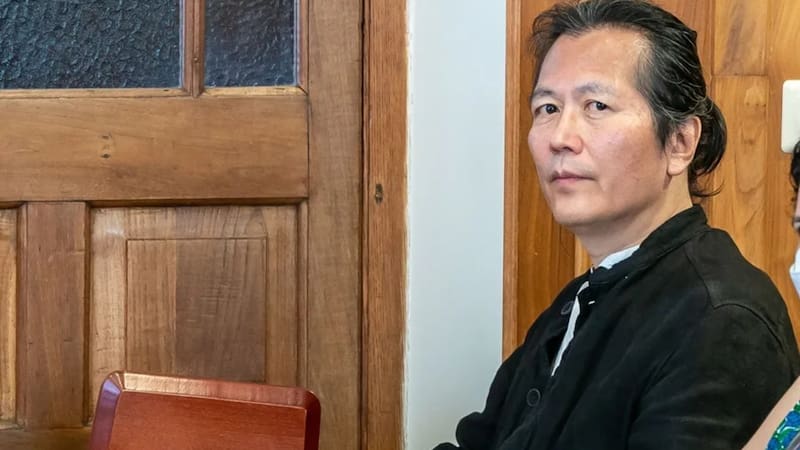
Byung-Chul Han, the South Korean philosopher and author of The Burnout Society
Born in Seoul in 1959 and based in Germany since age 22, Byung-Chul Han studied German literature and theology in Munich and philosophy in Freiburg, where he earned his doctorate with a dissertation on Heidegger. In 2025, he received the Princess of Asturias Award for Communication and Humanities.
He became known for The Burnout Society, in which he portrayed people worn down by self-imposed demands, and since then, his work has explored themes such as technology, work, transparency, and power, in titles including Psychopolitics, Infocracy, and Nonthings.