
En esta noticia
Searching for new alternatives to turn seawater into freshwater in a sustainable way is a global goal to increase access to this vital resource.
Within that framework, a new system that seeks to make this goal a reality was developed by the University of Rochester.
What is most novel is that, according to the experts, the process is carried out in an energy-efficient way and makes it possible to produce freshwater while bypassing many of the bottlenecks by allowing mostly usable products to be extracted instead of waste and doing so without added chemicals.

How this new system works to turn seawater into freshwater
The specialists, who explain the model in an article published on May 26 of this year by Light: Science & Applications, developed a device that uses black metal panels treated with a special laser. It works as follows:
- The panel surface comes into contact with a thin layer of salt water
- The water spreads across the panel -whose surface attracts and facilitates the movement of the resource-
- Because the black panel can absorb a lot of radiation, the heat concentrates in that layer of water
- The water turns into vapor, but the salt does not evaporate with it
- Freshwater is obtained through distillation
- The salt and minerals move toward the sides of the panel, where they accumulate
The method that makes it possible to solve one of the biggest problems that existed until now
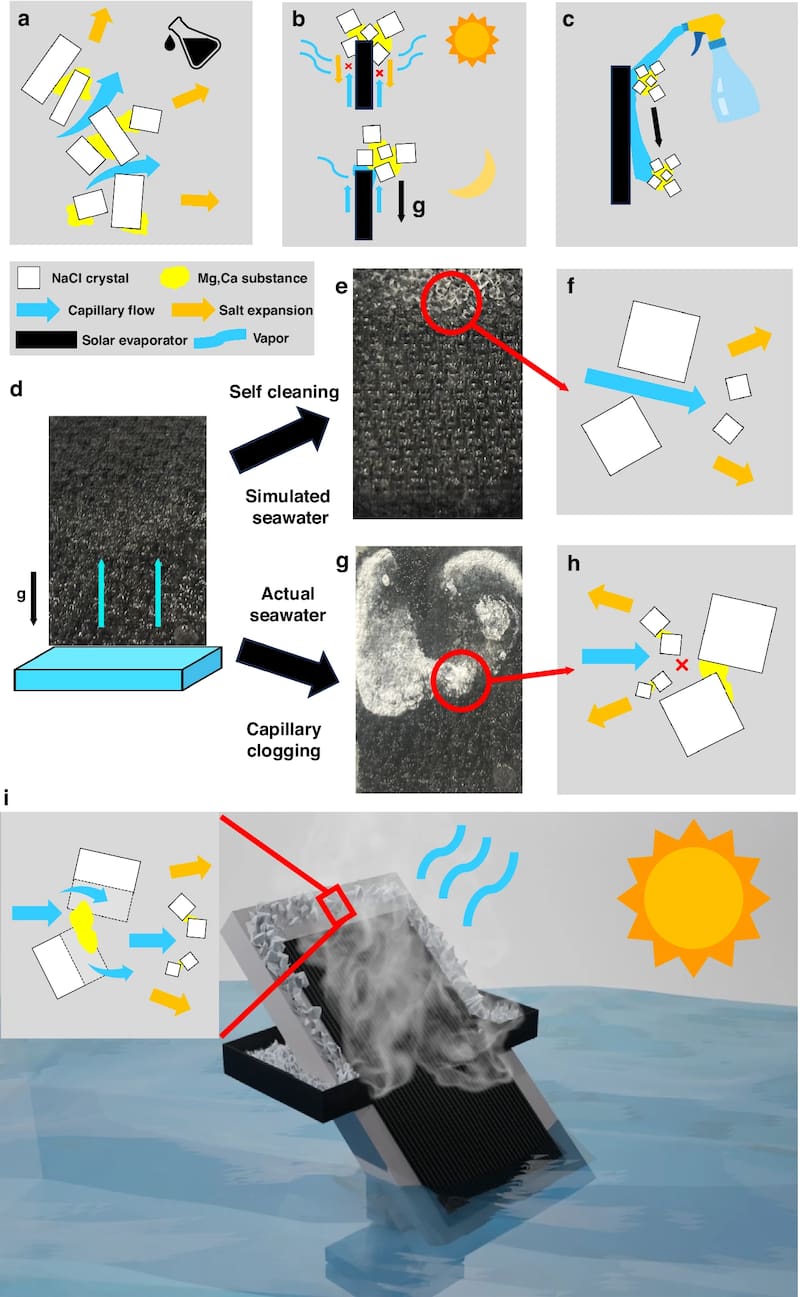
According to the experts, in traditional solar desalination plants, salt can build up on the area used to heat and evaporate the water. This is inefficient for the process and can even interfere with its proper functioning.
In this case, the developed panel has small metal grooves that allow the salts and minerals to move toward the edges as the water evaporates.
This solution was conceived by applying the well-known principle of the “coffee ring”: when a drop of coffee is spilled on the table and left to dry, the water disappears, but the product’s own particles concentrate, forming a ring.
In the same way with this process, as the water evaporates, the salts concentrate and instead of obtaining a problematic residue -such as brine- the system obtains solid salts. The method was tested with water from the Pacific, Atlantic, and Indian oceans, showing efficiency.
According to the explanation, usable products could be extracted from the “waste,” such as table salt or lithium, which is essential for battery operation.
Although the experts emphasized that this technology was tested on a small scale, they hope it can be applied in larger systems and help make freshwater available.