

En esta noticia
Auroras are a spectacular phenomenon, but not exclusive to Earth. On different bodies in the Solar System, charged particles interact with magnetic fields and generate emissions that can be detected even in radio waves.
In a novel discovery, a team of astronomers managed to identify a signal of this type in Beta Pictoris b, a giant exoplanet located about 64 light years away, and presented evidence of a much stronger magnetic field than Earth’s.
Relevant information for understanding the research: How are auroras formed?
Auroras are produced when charged particles, mainly electrons, are guided by a magnetic field and end up interacting with a planet’s atmosphere. In the case of Earth, this phenomenon occurs near the poles and can be seen as green, violet, or reddish lights in the sky.
However, this phenomenon can also produce radio waves, since electrons accelerated along magnetic field lines can generate an emission called Electron Cyclotron Maser Emission (ECMI), a mechanism that is also detected on other planets in the Solar System such as Jupiter, Saturn, Uranus, and Neptune.
When studying distant planets, this data is key because it is the frequency of these waves that makes it possible to estimate the density and intensity of a magnetic field.
Why can an exoplanet have auroras like Earth?
For auroras to occur, a magnetic field, charged particles, and some mechanism capable of accelerating these particles are needed.
In the case of Beta Pictoris b, radio emissions between 0.85 and 3.5 GHz were recorded. That implies a magnetic field that must reach at least 1.24 kilogauss, while Earth’s magnetic field is around 0.00025 to 0.00065 kilogauss.
In addition, it spins rapidly on itself with a rotation period of approximately 9 hours, a rotation that can cause differences in speed between different regions of the magnetosphere and generate electric currents capable of accelerating electrons and producing the detected radio emissions.

What is known about this exoplanet and its closest star?
According to the work of KN Ortiz Ceballos and Edo Berger from the Harvard and Smithsonian Center for Astrophysics and Yvette Cendes from the University of Oregon that was published on arXiv on September 15, Beta Pictoris b is a giant planet located about 63 light years from Earth, within the Beta Pictoris system.
The exoplanet has a mass 12 times that of Jupiter and orbits its star at a distance close to ten times the distance between Earth and the Sun. It completes one orbit around its star approximately every 24 years.
It is an extremely hot world since its effective temperature is around 1,700 Kelvin, close to 1,430 °C.
Its host star, Beta Pictoris A, is an A6V-type star and is considered magnetically quiet.
The researchers were able to locate the radio source at the position of Beta Pictoris b and determined that it was incompatible with the star’s location. They also ruled out that it came from the planet Beta Pictoris c.
The observed waves require a field of at least 1.25 kG, while the estimated limit for the star’s dipolar field is below approximately 0.3 kG.
Research background: How long did it take them to confirm their theories?
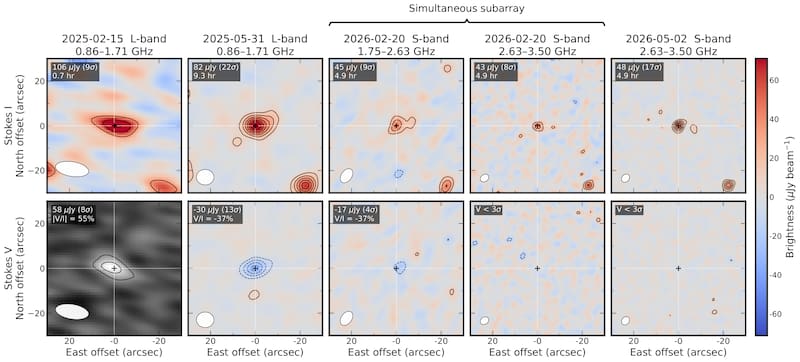
The first detection occurred in February 2025, during a broader campaign seeking radio emissions from ultracool dwarfs and exoplanets. After finding the signal, the team carried out new observations specifically aimed at checking whether it appeared again.
The astronomers observed the system on four occasions between February 2025 and May 2026, using different frequency bands. The latest session made it possible to detect a burst with around 70% circular polarization that reached 3.5 GHz. That frequency was key to establishing the minimum limit of 1.25 kilogauss for the planet’s magnetic field.