
En esta noticia
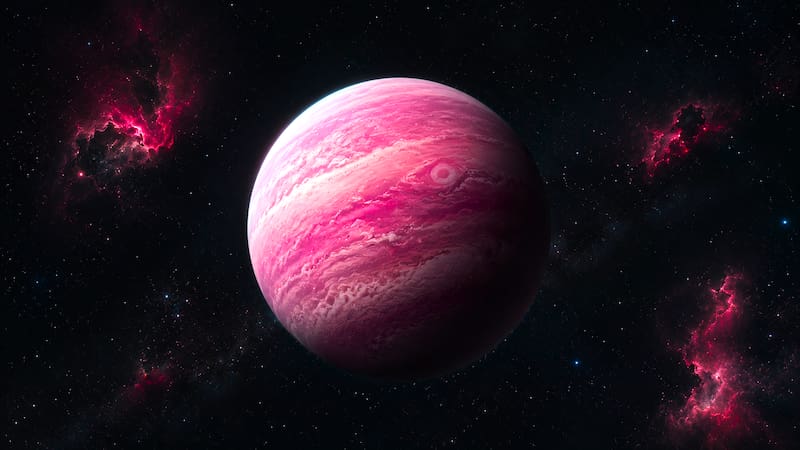
A team of astronomers, led by researchers at Northwestern University, has managed to solve one of the greatest enigmas of the known “Pink Planet”, an extremely cold object located approximately 57 light-years from Earth that for more than a decade puzzled experts.
As a result of observations carried out by the James Webb Space Telescope (JWST), the researchers discovered that its atmosphere contains water vapor, methane, carbon dioxide, ammonia, and salt clouds, a feature that had not been able to be confirmed in such a cold planetary object.
These findings were published on June 18 in The Astronomical Journal.

What scientists found on this pink planet
This object, known as GJ 504 b, was discovered in 2013 and orbits a star similar to the Sun, located 57 light-years away.
Although it is known as the pink planet because of its hue, experts are still not entirely sure that it is a planet.
Within that framework, over the years different teams tried to study the object, although its faint brightness prevented obtaining concrete information about its atmosphere; the James Webb Space Telescope managed to capture its appearance using a two-hour observation technique and subtracting the brightness of the star it orbits. The analysis identified the presence of
- Water vapor
- Methane
- Carbon dioxide
- Ammonia
- Various molecules
Why finding salt clouds is important for science
When the observations were attempted to be reproduced by computer models, the experts agreed that the results did not show realistic physical conditions, and this is due to the presence of salt clouds.
According to the study, the clouds hide the deeper layers of the atmosphere and alter the light that reaches the telescope.
The researchers concluded that this is one of the first direct pieces of evidence that salt clouds can exist in such a cold planetary object, confirming a possibility proposed by theoretical models more than 15 years ago.
The experts remain optimistic that the techniques used for this research can be replicated in the future to study other cold and dim worlds, making the analysis and study of their atmospheres easier.