
En esta noticia
What began as a search for a place to camp ended up becoming a scientific discovery. An amateur astronomer was exploring satellite images of a region of Canada when he identified a circular formation that caught his attention.
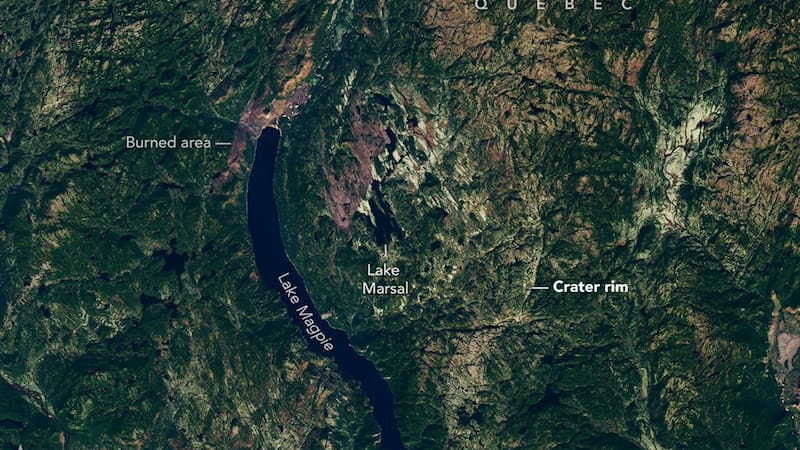
The discovery occurred in 2024, when Joël Lapointe was organizing a trip to the Côte-Nord region, in the province of Quebec. While looking at the terrain on digital maps, he detected a depression near Lake Marsal and began to suspect that it could be an ancient impact crater.
According to NASA, his observation sparked an investigation that made it possible to identify evidence of an impact that occurred approximately 390 million years ago.

How did he discover the crater while looking for a place to camp?
In 2024, Lapointe was using satellite images to explore possible places to camp in a remote area of Quebec.
During that search, he observed a circular structure near Lake Marsal that stood out in the landscape. The shape of the terrain aroused his curiosity and led him to consult with specialists from Europe and North America.
From those consultations, a group of French researchers began to study the possibility that the area corresponded to an ancient meteorite impact.
The investigation also aroused the interest of Gordon Osinski, a planetary geologist at Western University in Canada, who was initially skeptical about the hypothesis.
However, he decided to take part in a scientific expedition to examine the site.
What did the scientists find in the crater in Canada?
In October 2025, the researchers arrived in the Lake Marsal region to study the geological characteristics of the terrain.
The expedition faced difficulties due to the conditions of the site, characterized by swampy areas, dense vegetation and difficult access.
During the fieldwork, the specialists found particular structures in the rocks known as fracture cones, which are characteristic evidence of meteorite impacts.
According to NASA, these clues allowed them to support the hypothesis that the circular formation had been produced by the “collision of an extraterrestrial object against the Earth’s surface”.
The researchers determined that the structure is approximately 25 kilometers in diameter and would have formed about 390 million years ago.

What is the crater called and what importance does the discovery have?
The research team began calling the structure Uhackatik, after consulting with the Innu Council of Ekuanitshit, an indigenous community in the region.
NASA explained that scientists consider the crater’s origin confirmed by the evidence found, although at the time of publication formal recognition by a committee of the Meteorical Society was still pending.
Given its size, it is one of the most important impact structure discoveries in recent years.