
En esta noticia
This week, one of the most intense geomagnetic storms of the year will be recorded. The NOAA Space Weather Prediction Center issued a G3 geomagnetic storm alert for Thursday, June 4, and Friday, June 5, with northern lights visible from more than 20 U.S. states.
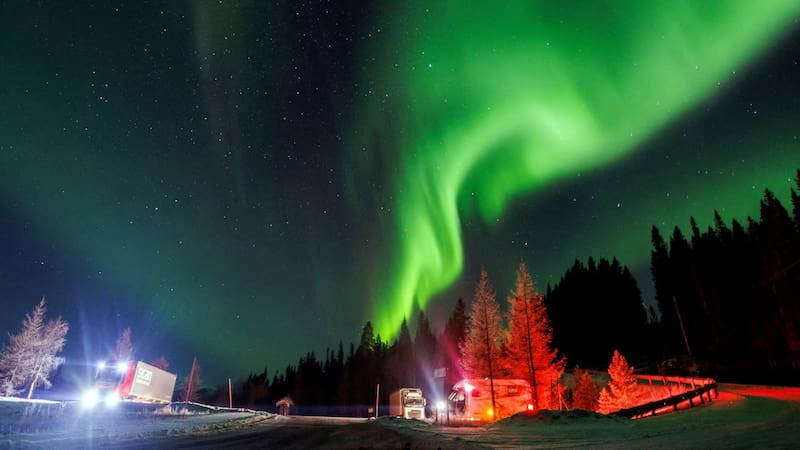
A G3 storm is considered “strong” and pushes the northern lights away from the poles, making them brighter and more active. For those who live in the northern part of the country, the opportunity is historic: the skies could light up with flashes of green, red, blue, and pink during the next night.

When and where to see the northern lights this week?
The most intense geomagnetic activity is expected in a specific time window. On Friday, June 6, between 8 p.m. and 11 p.m. ET, according to NOAA’s three-day forecast. It is recommended to look for a place away from light pollution with a clear northern horizon.

These are the states where it will be possible to see the northern lights, according to NOAA:
Best visibility
- Alaska
- Idaho
- Maine
- Michigan
- Montana
- North Dakota
- Oregon
- South Dakota
- Washington
- Wyoming
Possible visibility
- Connecticut
- Illinois
- Indiana
- Massachusetts
- Minnesota
- Nebraska
- New Hampshire
- New York
- Ohio
- Pennsylvania
- Rhode Island
- Vermont
- Wisconsin

What is a G3 geomagnetic storm and what can it affect?
The northern lights are a natural phenomenon produced when electrically charged particles from space enter Earth’s atmosphere and collide with oxygen and nitrogen molecules. As they return to their normal state, those particles release energy in the form of light.
Earth’s magnetic field redirects the particles toward the poles, generating the spectacular display of rays, spirals, and flashes that has fascinated humanity for millennia.
Beyond the visual spectacle, a G3 storm can have specific impacts on different systems:
Power systems
Voltage corrections may be required, and false alarms may be triggered in some protection devices.
Satellite operations
Surface charging of satellite components may occur, increased drag on low-Earth-orbit satellites, and the need for corrections due to orientation problems.
Navigation and communications
Intermittent problems may be recorded in satellite navigation, low-frequency radio navigation, and HF radio.