En esta noticia
The United States continues to advance with the development of the LGM-35A Sentinel, the intercontinental ballistic missile intended to replace the Minuteman III, a system that has remained in service since 1970.
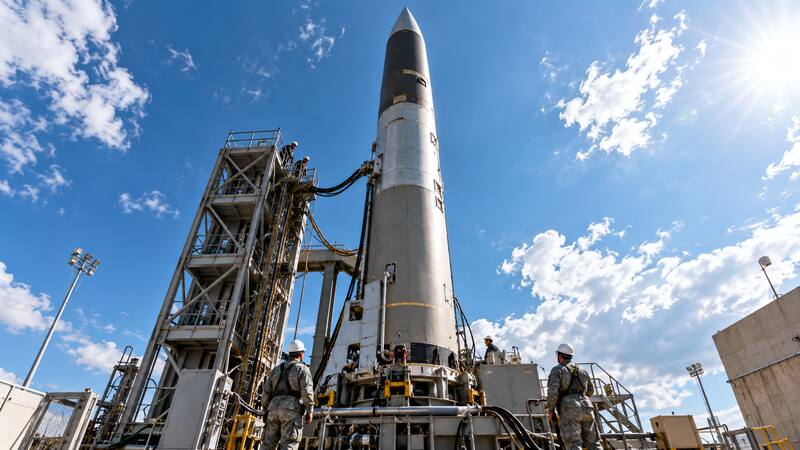
The program reached a new milestone with the missile fully assembled in a vertical position during a test carried out at Vandenberg Space Force Base, California.
How is the United States’ Sentinel nuclear missile made up?
The LGM-35A Sentinel is designed as a multistage intercontinental ballistic missile. During the exercise known as Pathfinder, teams managed to mount their three propulsion stages, the upper section, and the other components as a single unit.
Among its features, the following can be identified:
- Three solid-fuel engines, responsible for propelling the different stages of the missile.
- An official range of more than 6,000 miles, equivalent to more than 9,600 kilometers.
- A speed estimated by the Air Force at around Mach 23 at the end of the boost phase.
- Capability to be launched from land-based silos, as part of the land-based component of the U.S. nuclear triad.
It is planned to deploy approximately 400 Sentinel units at facilities located in Wyoming, Montana, and North Dakota.

When is the United States’ Sentinel nuclear missile expected to be ready?
The timeline includes several years of testing before the Sentinel enters service, but the first flight test is scheduled for 2027, when it will have to demonstrate in real conditions the procedures and systems that so far could only be evaluated on the ground.
Initial operational capability is scheduled for the early 2030s, when it would begin replacing the Minuteman III. If everything goes according to plan, the program intends for Sentinel to remain operational until at least 2075.