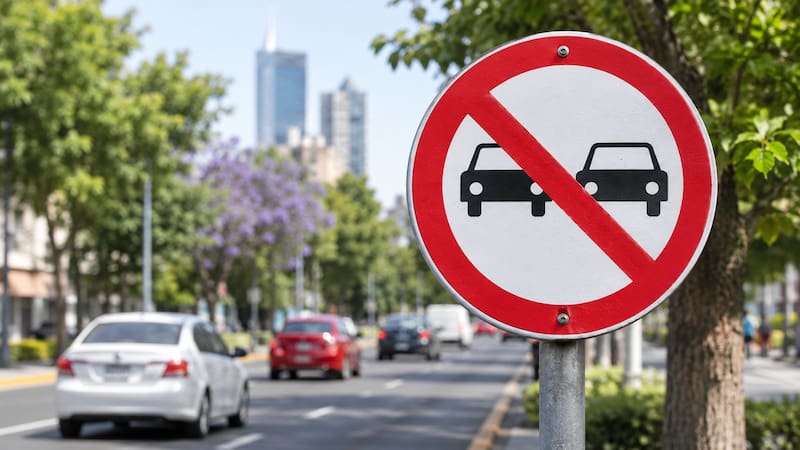

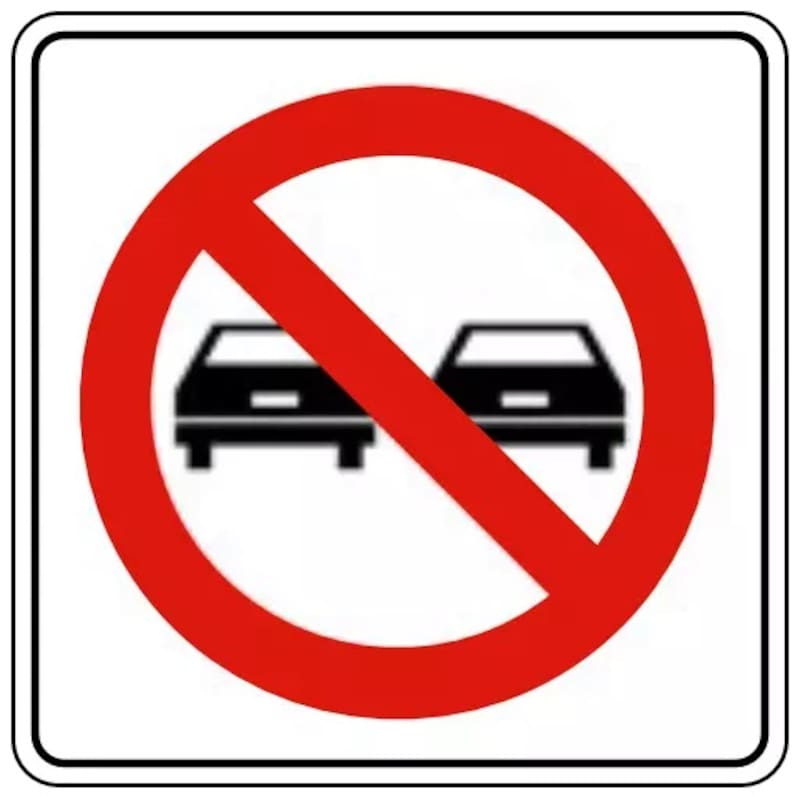
The traffic sign with two cars and a red diagonal line in Mexico means that passing is prohibited. Identified as SR-18 in the Manual of Signage and Devices for Traffic Control on Streets and Highways, it sets a restriction on passing other vehicles at certain points along the road.
Its presence warns that road conditions do not allow this maneuver to be carried out safely. For that reason, drivers must obey it and stay in their lane, without crossing into oncoming traffic to pass another vehicle.

Where is the no-passing sign used?
Mexico’s signage manual says the SR-18 sign is placed mainly on two-lane roads where visibility to pass is limited, on narrow bridges, and near at-grade intersections.
It is also paired with the M-1, a center line separating traffic directions, which marks opposing traffic directions and can reinforce the ban on passing.
The pictogram makes it possible to identify the type of vehicle the restriction applies to. For that reason, drivers should pay attention to both the upright sign and the markings on the pavement.
What is the fine for ignoring the no-passing sign?
The penalty for failing to comply with this instruction depends on the traffic rules in force in each state or jurisdiction.
For example, in Mexico City, Article 8 of the Traffic Regulations states that drivers must obey road signs. Failing to do so can be punished with:
- Fine of 10, 15, or 20 UMA, depending on the level applied.
- Three penalty points on the driver’s license.
- One point on the vehicle registration is assigned when the violation is detected by technological systems.
In addition, Article 11 of the capital’s regulations sets specific penalties for passing in the opposite lane under prohibited conditions, such as when there is a solid center line or there is not enough visibility. In those cases, the fine is 20, 25, or 30 UMA and three points on the license.
When this sign appears, drivers must stay behind the vehicle in front and wait until they reach a stretch where passing is allowed and can be done safely.