
En esta noticia
The balance of power around the Strait of Hormuz appears to be changing as commercial vessels increasingly ignore Iran’s demands and use an alternative route along the coast of Oman.
More than 80% of vessel transits through the Strait of Hormuz over the past two weeks have used the Omani route, according to shipping data from Kpler cited by CNN. The shift is particularly significant because almost no commercial traffic was using that route just one month ago.
The development provides one of the clearest indications yet that Iran’s ability to control maritime traffic through the strategic waterway has weakened, even though Tehran continues to claim that it controls the strait.
The route that is changing the battle for hormuz
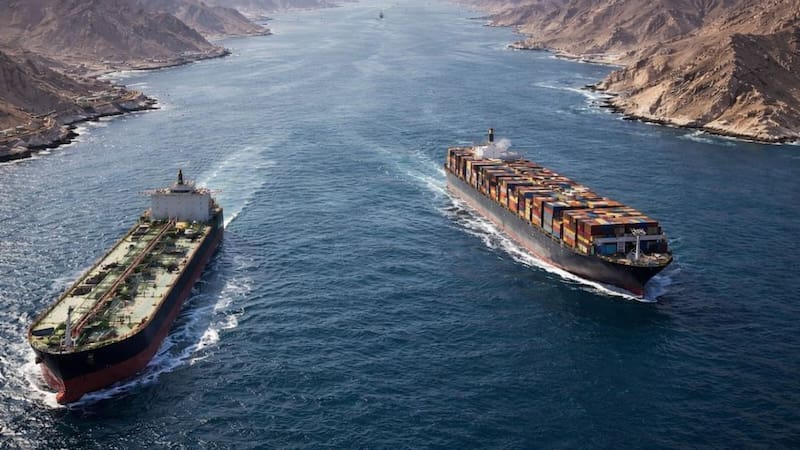
The Omani route follows the northern coast of Oman as vessels cross the Strait of Hormuz.
Iran has strongly opposed ships using this corridor and has attacked vessels attempting to cross through the Omani side of the waterway. Despite those risks, an increasing number of commercial ships have chosen the route, in some cases with the expectation of protection from U.S. naval forces.
The change is important because the Strait of Hormuz is not simply another shipping lane.
It is one of the world’s most important energy chokepoints, connecting the Persian Gulf with the Gulf of Oman and the Arabian Sea. Before the current conflict, roughly one-fifth of global oil and liquefied natural gas shipments passed through the waterway.
More than 80% of vessels are now using the omani side
The most striking figure comes from Kpler’s maritime tracking data.
More than 80% of vessels that crossed the Strait of Hormuz during the previous two weeks used the Omani route. That represents a dramatic change in shipping behavior.
Only weeks earlier, commercial vessels were largely avoiding that corridor. The fact that so many ships are now choosing it suggests that Iran is having greater difficulty enforcing its demands across the entire waterway. However, the figure needs to be interpreted carefully.
It does not mean that 80% of the world’s oil is currently moving through Oman. It refers to the proportion of recorded vessel transits through the strait that have recently chosen the Omani route.
That distinction is important because overall shipping through Hormuz remains far below normal levels.
Shipping through hormuz is still dramatically reduced
Despite the increase in vessels using the Omani route, maritime traffic remains severely disrupted.
Kpler data cited by Reuters showed that only six commodity vessels passed through the Strait of Hormuz on Tuesday, August 18, compared with nine the previous day and an average of about 11 daily transits in the recent period.
That is still a tiny fraction of normal activity.
Before the war, more than 130 vessels could pass through the waterway in a single day, according to shipping data cited by Reuters.
As a result, the apparent weakening of Iran’s control should not be confused with a return to normal shipping conditions.
The strait remains one of the most dangerous and closely watched maritime corridors in the world.
Trump claims the united states has control
The changing traffic pattern comes as President Donald Trump has repeatedly claimed that the United States has control over the Strait of Hormuz.
Iran disputes that claim and continues to insist that the waterway remains closed or subject to its authority.
The two governments therefore offer dramatically different descriptions of the situation.
But the shipping data provide a more concrete indication of what is happening at sea: commercial vessels are increasingly willing to cross using the Omani side despite Tehran’s objections.
That does not mean Iran has lost all of its ability to disrupt shipping.
Instead, analysts say Tehran’s ability to deter or control vessels appears to have diminished compared with earlier stages of the conflict.

The shift could have major consequences for oil markets
The Strait of Hormuz normally carries a huge portion of the world’s energy supplies, which means any disruption can quickly affect crude prices.
The current crisis has already pushed oil prices significantly higher.
Reuters reported that Brent crude was trading around $90 a barrel as the market increasingly priced in the possibility that the Hormuz disruption could last longer than initially expected.
The problem is that alternative routes cannot completely replace the capacity normally available through the strait.
Some Gulf producers have therefore begun looking for other ways to move crude to international markets.
Saudi Arabia, for example, has resumed some oil loadings inside the Strait of Hormuz and has explored ship-to-ship transfers near the UAE’s Fujairah in an effort to keep exports moving despite the security risks.
Why the omani route matters
The growing use of the Omani route is significant for another reason.
It demonstrates that Iran’s ability to dictate how every commercial vessel crosses the strait is becoming harder to enforce.
If ships continue to use the corridor despite Iranian warnings, Tehran’s leverage over international shipping could gradually decline. At the same time, the route is not risk-free.
Iran has attacked vessels attempting to use the Omani side, meaning that ships choosing this corridor are still operating under substantial military and security risks.
The United States has responded by maintaining naval forces in the area and offering protection to some vessels.